Public note
What is Deer-Flow? A Beginner-Friendly Guide to ByteDance's AI Workflow Engine
Deer-Flow is an open-source AI workflow engine by ByteDance, designed to help developers manage and run complex AI workflows. It offers a beginner-friendly approach to creating modular and reusable pipelines for various AI tasks.
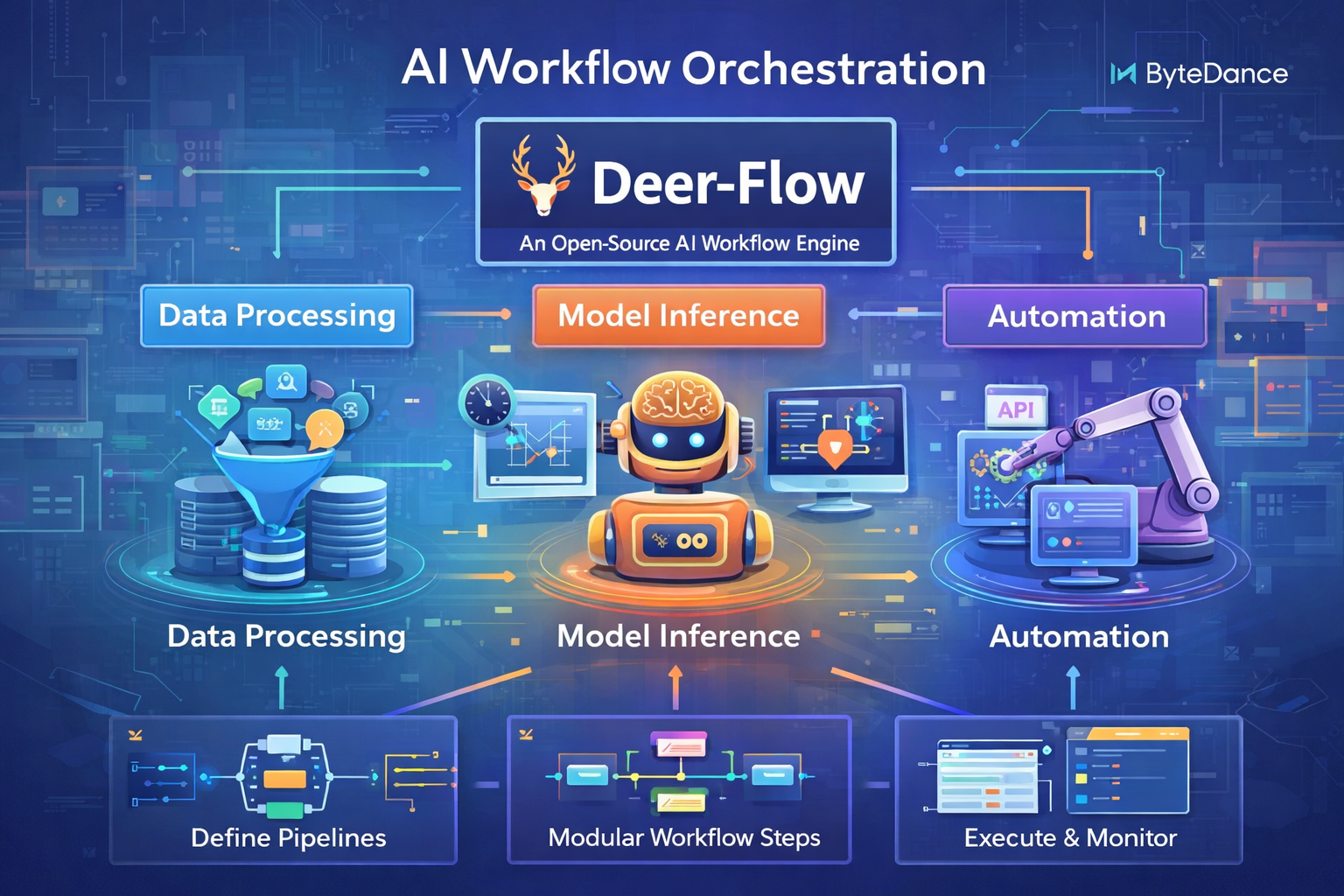
What is Deer-Flow?
Deer-Flow is an open-source AI workflow engine developed by
ByteDance that helps developers build, manage, and run complex AI-driven
workflows more easily.
In simple terms, Deer-Flow allows you to connect multiple steps---such
as data processing, model inference, and automation---into a structured
pipeline. Instead of writing scattered scripts, you can organize
everything into a clear, reusable workflow.
This makes it especially useful for:
- Beginners learning AI workflows
- Developers building automation systems
- Teams managing complex AI pipelines
If you've ever wondered how modern AI systems chain multiple steps
together (like data → model → output), Deer-Flow is designed to solve
exactly that problem.
How does it work?
At its core, Deer-Flow works like a workflow orchestration system.
Think of it like a flowchart:
- You define steps (nodes)
- Each step performs a task (e.g., run a model, process data)
- Steps are connected into a pipeline
- The system executes them in order
Key Concept (Simplified)
- Nodes → Individual tasks
- Edges → Connections between tasks
- Flow → The complete pipeline
Instead of manually handling execution logic, Deer-Flow:
- Manages dependencies
- Controls execution order
- Handles data passing between steps
This approach is especially powerful in AI systems, where workflows
often include:
- Data preprocessing
- Model inference
- Post-processing
- Logging or storage
Key Features
1. Workflow-Based Design
Deer-Flow lets you define processes as workflows instead of scripts.
👉 Why it matters:
Easier to understand, debug, and maintain.
2. Modular Architecture
Each step in the workflow is independent and reusable.
👉 Why it matters:
You can reuse components across different projects.
3. AI Pipeline Support
Built specifically with AI workflows in mind.
👉 Why it matters:
Perfect for chaining models, APIs, and data processing.
4. Scalable Execution
Designed to handle simple tasks and complex pipelines.
👉 Why it matters:
Works for both small experiments and production systems.
5. Open Source Flexibility
Fully open-source and customizable.
👉 Why it matters:
You can modify it to fit your needs without vendor lock-in.
Pros and Cons
✅ Pros
- Beginner-friendly workflow concept
- Great for organizing AI pipelines
- Modular and reusable components
- Open-source and flexible
- Suitable for automation and orchestration
❌ Cons
- Still relatively new (smaller ecosystem)
- Requires some understanding of workflows
- Documentation may not be beginner-perfect yet
- Not as widely adopted as older tools (e.g., Airflow)
How to use Deer-Flow (Step-by-step)
Step 1: Clone the Repository
git clone https://github.com/bytedance/deer-flow.git
cd deer-flow
Step 2: Install Dependencies
pip install -r requirements.txtStep 3: Define a Simple Workflow
Input → Process → Output
Step 4: Configure Nodes
- Load data
- Run model
- Save result
Step 5: Run the Workflow
python run_flow.pyStep 6: Monitor Results
Check outputs and logs.
Use Cases
1. AI Model Pipelines
Chain multiple AI models together.
2. Data Processing Automation
Automate data workflows.
3. Content Generation Systems
Blog, image, and media generation pipelines.
4. Backend Automation
API workflows and data sync.
5. Experiment Management
Run AI experiments systematically.
Comparison
Deer-Flow vs Apache Airflow
| Feature | Deer-Flow | Airflow |
|---|---|---|
| Focus | AI workflows | General workflows |
| Complexity | Beginner-friendly | More complex |
| Setup | Lightweight | Heavy |
| Ecosystem | Growing | Mature |
Deer-Flow vs LangChain
| Feature | Deer-Flow | LangChain |
|---|---|---|
| Purpose | Workflow engine | LLM framework |
| Focus | Pipeline orchestration | Prompt & LLM chaining |
FAQ
1. What is Deer-Flow used for?
AI workflow orchestration.
2. Is Deer-Flow beginner-friendly?
Yes.
3. Is Deer-Flow better than Airflow?
Different use cases.
4. Can I use Deer-Flow for production?
Yes, with evaluation.
5. Does Deer-Flow support LLMs?
Yes.
Conclusion
Deer-Flow simplifies AI workflow development and is a great starting
point for beginners.
External References
- https://github.com/bytedance/deer-flow
- https://airflow.apache.org
- https://docs.langchain.com