Public note
Thunderbolt: Thunderbird’s Bid to Build an AI Client You Can Actually Control
Thunderbolt is an open-source, cross-platform AI client developed by Thunderbird that prioritizes self-hosting, model choice freedom, and enterprise deployment flexibility. It aims to be a secure alternative to vendor-tied chatbot services.
Subheadline
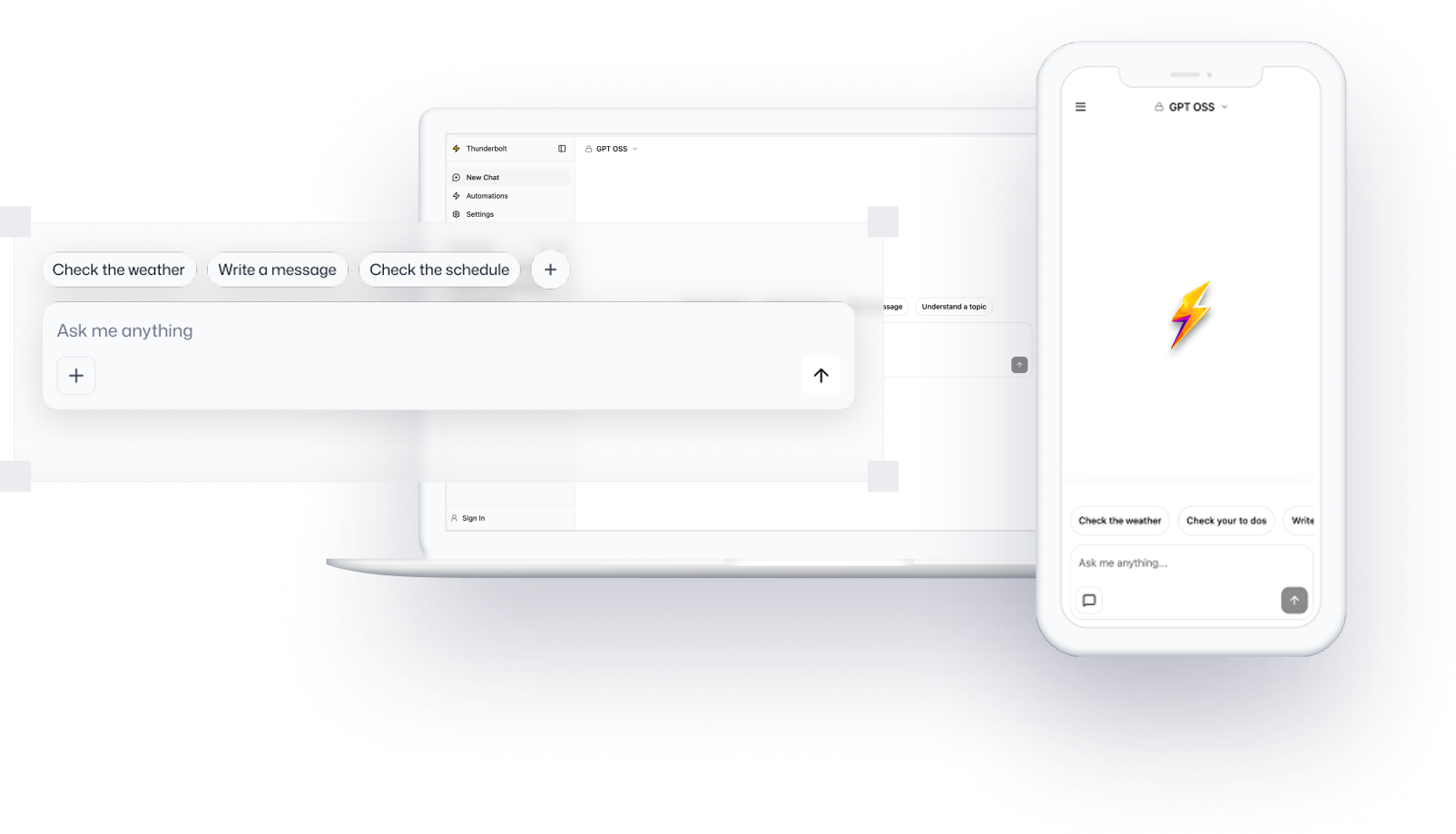
Mozilla’s Thunderbird team is developing Thunderbolt as an open-source, cross-platform AI client designed around self-hosting, model choice, and enterprise deployment rather than a single hosted chatbot experience.
Lead
Thunderbolt is not an email add-on or a thin wrapper around one AI model. In the repository, Thunderbird describes it as “AI You Control,” with the project centered on three promises: choose your models, own your data, and avoid vendor lock-in. That framing places Thunderbolt closer to an enterprise-ready AI workspace client than to a consumer chatbot app.
At a Glance
- Project: Thunderbolt
- Owner: Thunderbird
- What it is: An open-source, cross-platform AI client
- Target posture: Self-hosted, on-prem capable, model-agnostic
- Current state: Early, under active development, not yet production ready
What Happened
The thunderbird/thunderbolt repository presents Thunderbolt as an open-source AI client that can run across web, desktop, and mobile platforms. The README says the project is aimed especially at enterprise users that want to deploy it on-prem, while also warning that the software remains under active development and is still undergoing a security audit.
That matters because the project’s pitch is unusually explicit about control. Instead of bundling users into a single inference provider, Thunderbolt asks users to bring their own model providers. The repository recommends local inference options such as Ollama or llama.cpp, while also allowing OpenAI-compatible API providers.
Key Facts / Comparison
| Area | What the repository says |
|---|---|
| Positioning | “AI You Control: Choose your models. Own your data. Eliminate vendor lock-in.” |
| Deployment | Self-hosted and deployable on-prem |
| Platforms | Web, iOS, Android, Mac, Linux, Windows |
| Model support | Frontier, local, and on-prem models |
| Current maturity | Early, under active development, not production ready |
| Enterprise stance | Security audit in progress; enterprise production readiness in preparation |
Background and Context
Thunderbird is best known for email and productivity software, so Thunderbolt stands out as a broader AI infrastructure play. The repo does not position it as a mail-specific assistant. Instead, it describes a general AI client architecture with support for multiple model backends, enterprise authentication, synchronization infrastructure, and optional end-to-end encryption.
The architecture document shows a split between an on-device client and a self-hostable server layer. On device, the stack uses a React frontend, local state management, an AI chat layer, optional end-to-end encryption, and SQLite as the offline-first data store. On the server side, the project uses an Elysia-on-Bun backend, authentication services, an inference proxy, PowerSync, and PostgreSQL.
Why This Matters
Many AI clients today are effectively front ends for one vendor’s hosted model. Thunderbolt is trying to offer a different answer: let organizations decide where inference happens, what providers are allowed, and whether the system runs in their own environment.
That makes the project interesting for companies with stricter security, compliance, or data residency requirements. The repository’s deployment documentation is oriented around Docker Compose for evaluation and Kubernetes or Pulumi-based cloud infrastructure for larger environments, which reinforces that Thunderbolt is being shaped for managed organizational use rather than only individual experimentation.
Insight and Industry Analysis
The strongest part of Thunderbolt’s story is not model novelty. It is architectural positioning. Thunderbird is attempting to turn model choice and deployment flexibility into product features.
That gives the project a credible niche if it can mature technically. Enterprises increasingly want the freedom to mix hosted APIs, local models, and on-prem inference without rewriting user workflows every time model economics or policy requirements change. A model-agnostic client with its own sync, auth, and policy layer could fit that need.
The challenge is equally clear in the repo: much of what makes Thunderbolt appealing is still marked as in development, preview, or planned. The project is ambitious, but the maintainers are also unusually direct that it is not yet ready for production use.
Strengths, Limitations, and Open Questions
Strengths
- Clear emphasis on self-hosting and vendor independence
- Broad cross-platform ambition from one codebase
- Support for local, hosted, and on-prem model strategies
- Architecture already accounts for auth, sync, and inference routing
Limitations
- The project explicitly says it is not production ready
- Some capabilities remain in preview or planned status
- The end-to-end encryption design is still under development and not yet cryptography-audited
- Offline-first is part of the architecture, but the README says some functions still depend on authentication and search today
Open Questions
- How quickly will preview features become stable enterprise features?
- How complete will offline support become relative to the project’s long-term vision?
- What governance and admin tooling will emerge for large deployments?
Technical Deep Dive
The architecture document outlines a modern client-server design.
On the client side, Thunderbolt uses React 19, Vite, Radix UI, Zustand, TanStack Query, Drizzle, the Vercel AI SDK, and an MCP client. SQLite is described as the offline-first local data store.
On the server side, the system uses an Elysia backend on Bun, Better Auth with OTP and OIDC, an inference proxy for routing model calls, PowerSync for synchronization, and PostgreSQL for storage. The deployment documentation also lists Keycloak and MongoDB in the container stack, with Docker Compose positioned as the fastest path for local evaluation.
Telemetry is documented separately. Thunderbolt says event tracking respects privacy settings, can be disabled through app settings, and does not collect personally identifiable information without explicit user consent. The repo states that it uses PostHog for analytics.
The roadmap suggests a product that is already fairly broad in surface area. Web, Mac, Linux, and Windows are marked available, while Android and iOS are listed as available with app store releases planned. Features such as OIDC, chat widgets, chat mode, search mode, custom model providers, Google integration, Microsoft integration, and Ollama compatibility are marked available, while optional end-to-end encryption, cross-device cloud sync, tasks, research mode, and MCP support are listed as preview or in development.
What to Watch Next
- Whether the security audit materially changes deployment guidance
- How fast preview features such as E2E encryption and cloud sync mature
- Whether Thunderbird expands public documentation around enterprise administration and governance
- How the project balances offline-first goals with today’s auth and search dependencies
Conclusion
Thunderbolt is a serious attempt to build an AI client around control rather than lock-in. The repository does not promise a finished product yet, and the maintainers are careful not to overstate readiness. But the direction is clear: Thunderbird wants Thunderbolt to be an open, self-hostable AI client that organizations can run with their own models, their own infrastructure, and their own operational constraints.
If the team can convert that architecture into a hardened product, Thunderbolt could become one of the more notable open-source alternatives to vendor-tied AI workspaces.