Public note
Paperclip Wants to Be the Control Plane for ‘Zero-Human Companies’
Paperclip is an open-source project aiming to be the control plane for autonomous AI companies, offering a structured approach to manage multiple AI agents through company-like hierarchies and governance.
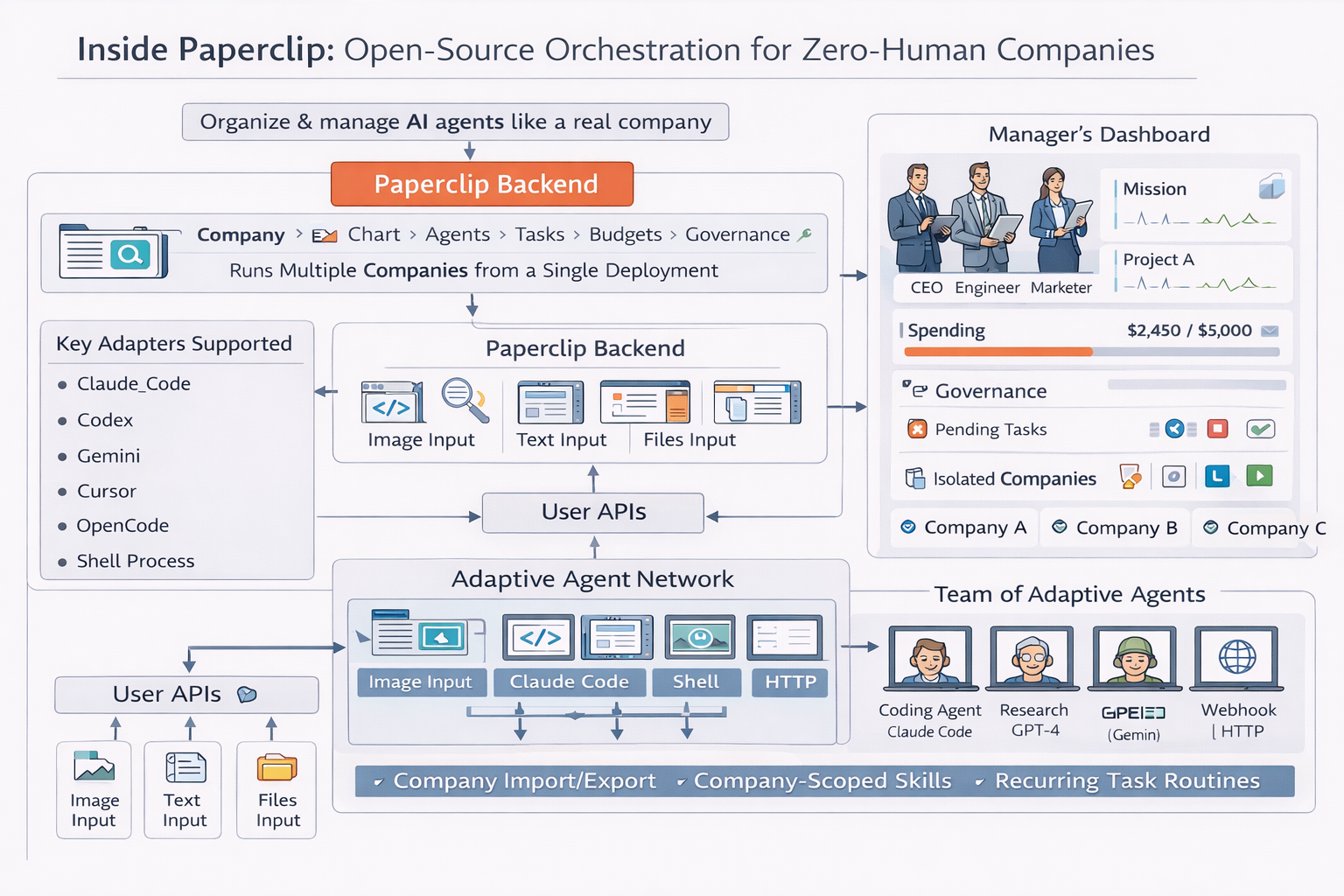
Subheadline
Paperclip is pitching itself as an open-source operating layer for AI-run businesses, combining agent orchestration with org charts, budgets, governance, and audit trails. The project’s rapid GitHub traction and expanding adapter model suggest it is trying to move multi-agent systems from experimentation into day-to-day operations.
Lead
Most AI agent tools still look like developer utilities: a CLI here, a workflow builder there, and a growing pile of disconnected automations in between. Paperclip is taking aim at that fragmentation with a more ambitious claim. Rather than acting as another single-agent framework, the open-source project presents itself as the control plane for autonomous AI companies—software designed to organize agents as if they were employees inside a real business.
That framing is what makes Paperclip interesting. It does not ask users to think in terms of prompts, scripts, or isolated bots. It asks them to think in terms of a company: hire a CEO, add engineers or marketers, define a mission, assign work, set budgets, and govern what those agents are allowed to do. In a market crowded with “AI agents” pitches, Paperclip is trying to sell structure.
At a Glance
- Paperclip describes itself as open-source orchestration for zero-human companies
- The platform is self-hosted, MIT-licensed, and launched through a one-command onboarding flow
- It organizes AI work around companies, agents, tasks, heartbeats, budgets, and governance
- Paperclip supports multiple agent runtimes through adapters, including Claude Code, Codex, Gemini, Cursor, OpenCode, OpenClaw, shell processes, and HTTP webhooks
- The project’s GitHub repository had roughly 47,800 stars and 7,700 forks when this report was prepared
- Recent releases show Paperclip is evolving quickly, with features such as company import/export, company-scoped skills, and recurring task routines
What Happened
Paperclip has emerged as one of the more talked-about open-source projects in the AI agent tooling space by packaging a familiar idea—coordinating multiple agents—inside a distinctly business-oriented interface. Its public messaging is unusually direct: “If OpenClaw is an employee, Paperclip is the company.”
That slogan captures the project’s core bet. Developers are no longer just looking for a way to run agents; they increasingly want a way to manage many agents without losing context, visibility, or cost control. Paperclip’s answer is to treat each agent as part of an organizational hierarchy, then layer task management, reporting lines, scheduled execution, approvals, and spend limits on top.
The result is a product that looks less like an automation pipeline and more like a dashboard for supervising an AI workforce. The company mission sits at the top, projects and goals cascade downward, and tasks are assigned to specific agents that wake up on a “heartbeat” schedule to review work, act, and report back.
Key Facts / Comparison
| Category | What Paperclip Offers |
|---|---|
| Positioning | Control plane for autonomous AI companies |
| License | MIT |
| Deployment | Self-hosted; local onboarding and embedded database option |
| Primary UX model | Company > org chart > agents > tasks > budgets > approvals |
| Core execution model | Heartbeat-driven agent wakeups plus event-based triggers |
| Runtime support | Adapter-based; local CLIs, shell process, and HTTP/webhook agents |
| Multi-tenancy | One Paperclip deployment can run multiple companies with data isolation |
| Governance model | Board-style approvals, budget enforcement, pause/terminate controls |
| Auditability | Ticket system, run records, tool-call tracing, and activity history |
Notable Built-In Adapter Coverage
| Adapter Type | Purpose |
|---|---|
claude_local | Runs Anthropic’s Claude Code CLI locally |
codex_local | Runs OpenAI Codex CLI locally |
gemini_local | Runs Gemini CLI locally |
cursor | Runs Cursor CLI locally |
opencode_local | Runs OpenCode CLI locally |
openclaw_gateway | Sends wake payloads to an OpenClaw gateway |
process | Executes arbitrary shell commands |
http | Invokes external agents through webhooks |
Background and Context
Paperclip arrives at a moment when the AI industry is shifting from chatbot experimentation toward more durable agent infrastructure. The hard part is no longer proving that a single model can write code, summarize documents, or answer questions. The hard part is coordinating multiple systems reliably over time.
That challenge has created a new category of tooling around orchestration, memory, approvals, observability, and cost management. Paperclip’s contribution to that category is its insistence that agent operations should mirror company operations. Instead of abstract graph nodes or workflow blocks, it uses titles, reporting chains, company missions, and managerial escalation.
This makes the product easier to explain to non-technical operators, but it also reflects a deeper technical decision. Paperclip does not try to be the model provider or the execution engine for every workload. Its documentation explicitly says it is a control plane, not an execution plane. In practice, that means it sits above existing runtimes and standardizes how they are triggered, monitored, and governed.
Why This Matters
For developers, startups, and operators experimenting with AI-heavy workflows, Paperclip points to a more opinionated future for agent systems—one where the real product is not the model, but the management layer around it.
Several groups could be affected:
- Indie builders and small teams: A way to coordinate multiple coding, research, marketing, and operations agents without manually juggling separate sessions
- Agent developers: A framework for plugging in their own runtimes through adapters rather than rebuilding control logic from scratch
- Operators and founders: A clearer governance model for approvals, budgets, and org-wide visibility
- Enterprise experimentation teams: A possible template for internal multi-agent deployments where auditability and spend limits matter as much as raw capability
Insight and Industry Analysis
Paperclip’s strongest idea is not technical novelty alone. It is product framing.
Most orchestration platforms are designed for engineers and described in infrastructure language. Paperclip instead uses management language: CEOs, org charts, board approvals, budgets, and company goals. That framing does two things at once. First, it makes a complex system more legible. Second, it encourages users to adopt stronger operational habits around accountability and cost control.
The project also reflects a broader market reality: AI agents are getting easier to launch but harder to supervise. Once teams have multiple agent sessions running across different tools, the operational overhead becomes its own problem. Paperclip is essentially monetizing—or, in open-source terms, productizing—that chaos.
Its early momentum on GitHub also matters. Open-source AI projects often attract attention faster than they prove staying power, but Paperclip’s recent release cadence and documentation depth suggest a project moving beyond a flashy demo. The existence of adapter docs, architecture docs, onboarding flows, a changelog, and public release notes all point to a team trying to build operational durability, not just social buzz.
At the same time, the “zero-human companies” tagline is more provocative than literal. In most real deployments, human supervision will remain central, especially for approvals, strategy, and exception handling. Paperclip appears to understand that tension and bakes in governance features accordingly.
Pros and Cons
Pros
- Clear mental model: Treating agents as employees makes multi-agent orchestration easier to reason about
- Adapter flexibility: Users are not locked into a single model vendor or runtime
- Operational guardrails: Budgets, approvals, and audit trails address real deployment pain points
- Strong self-hosting story: MIT license, local onboarding, and embedded database support lower barriers to entry
- Multi-company support: Useful for operators running separate ventures or experiments from one control plane
Cons
- Ambitious abstraction: The “company” metaphor may feel heavy or over-structured for simpler workflows
- Operational complexity: Running multiple agents responsibly still requires careful configuration and oversight
- Early-stage risk: Rapid feature growth can be a strength, but it can also create churn for adopters
- Limited proof outside public claims: Much of the strongest usage evidence still comes from Paperclip’s own reporting and community traction
- Governance depends on setup quality: Approval flows and budgets only work as well as the policies users define
Technical Deep Dive
Paperclip’s architecture is built as a monorepo with four main layers:
| Layer | Stack |
|---|---|
| Frontend | React 19, Vite 6, React Router 7, Radix UI, Tailwind CSS 4, TanStack Query |
| Backend | Node.js 20+, Express.js 5, TypeScript |
| Database | PostgreSQL 17 or embedded PGlite, using Drizzle ORM |
| Execution bridge | Adapter packages for supported agent runtimes |
How the execution loop works
Paperclip’s documentation describes a heartbeat-centric execution model:
- A trigger fires, such as a schedule, a manual invoke, or an event like assignment or mention
- Paperclip looks up the agent’s configured adapter
- The adapter launches or contacts the runtime
- The agent uses Paperclip’s API to inspect context, claim tasks, and update status
- Paperclip captures stdout, usage, cost data, and session state
- The run is recorded for auditability and future continuation
Core concepts that shape the product
- Company: top-level organizational unit with a mission, budget, task hierarchy, and employees
- Agents: AI workers with adapter configuration, role, reporting line, capabilities, budget, and status
- Issues (tasks): units of work with assignment, hierarchy, status, priority, and optional project/goal links
- Heartbeats: scheduled or event-driven wakeups that allow agents to keep work moving
- Governance: approvals, budget caps, and pause/terminate controls that keep autonomy bounded
Recent product signals from release notes
Paperclip’s recent GitHub releases and changelog suggest a project maturing quickly:
| Release Signal | Why It Matters |
|---|---|
| Company import/export | Makes organizations portable and easier to template, clone, or migrate |
| Company-scoped skills | Indicates deeper support for reusable institutional knowledge |
| Routines and recurring tasks | Moves the product beyond ad hoc tasks toward ongoing operations |
| Execution workspace tracking | Suggests growing attention to durable workspaces and state continuity |
| Browser-based CLI auth and improved health checks | Points to better developer ergonomics and maintainability |
What to Watch Next
- Whether Paperclip can convert GitHub attention into a durable developer ecosystem
- How far the adapter model expands beyond today’s local CLI and webhook integrations
- Whether “company templates” and skills libraries become a meaningful distribution layer
- How enterprises respond to the governance-and-audit angle versus lighter-weight orchestration tools
- Whether the project’s “zero-human companies” branding evolves as real-world deployments reveal where humans still need to stay in the loop
Conclusion
Paperclip is one of the clearest examples yet of where the AI agent market may be heading: away from isolated agents and toward structured operating systems for supervised autonomy. Its real innovation is not simply connecting more models. It is turning multi-agent coordination into something that resembles management.
That does not mean the future belongs to literal human-free businesses. But it does suggest that the teams building serious agent systems will increasingly need dashboards, approvals, budgets, reporting lines, and memory—not just better prompts. On that front, Paperclip is less a curiosity than an early blueprint.
References
- Paperclip GitHub repository
- Paperclip official website
- Paperclip blog
- Paperclip quickstart documentation
- Paperclip architecture documentation
- Paperclip core concepts documentation
- Paperclip adapters overview
- Paperclip HTTP adapter documentation
- Paperclip “What is Paperclip?” documentation
- Paperclip changelog
- Paperclip GitHub releases
- Paperclip blog: “Hire AI Agents Like Employees”
- Paperclip blog: “Who Is Actually Using Paperclip on GitHub?”