Public note
oh-my-claudecode: Why This Claude Code Orchestration Project Matters
Oh-my-claudecode is an orchestration layer for Claude Code that transforms AI coding into a structured team-based workflow, addressing common frustrations with manual coordination and lack of repeatability.
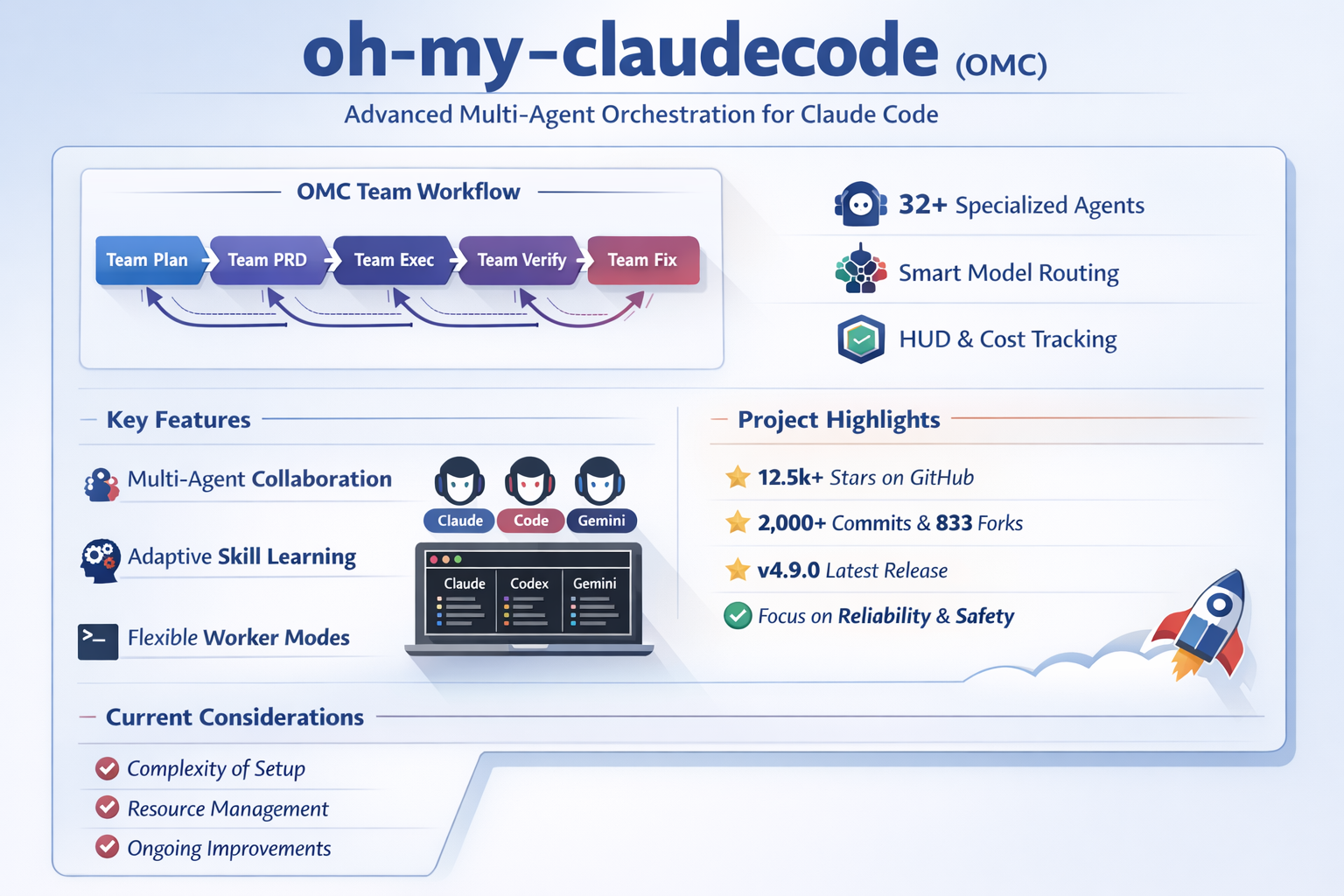
Summary
oh-my-claudecode is an open-source orchestration layer for Claude Code.
Its main idea is simple:
Instead of making users learn a lot of commands, roles, and manual agent coordination, OMC tries to turn Claude Code into a more automated team-based coding assistant.
For people interested in IT, the project is interesting because it reflects a bigger shift in AI software: tools are moving from single-assistant interaction to coordinated multi-agent workflows.
In plain English, OMC is trying to make AI coding feel less like chatting with one assistant and more like directing a small software team.
What the Project Is
The GitHub repository describes oh-my-claudecode as:
“Multi-agent orchestration for Claude Code. Zero learning curve.”
It also positions itself as teams-first, meaning the main experience is no longer just one agent doing one task. Instead, the preferred flow is a staged team pipeline.
The repository currently presents Team Mode as the recommended orchestration surface, with a pipeline like:
team-plan → team-prd → team-exec → team-verify → team-fix
That design is important because it gives the project a more structured shape than many AI coding tools. It is not just “ask the model to code.” It is:
- plan the task
- define requirements
- execute the work
- verify the result
- fix problems if needed
For non-developers, the easiest way to understand this is that OMC tries to make software work more like a repeatable process instead of an improvised conversation.
Why This Project Is Interesting
A lot of people are excited about AI coding, but there is still a common frustration:
- the assistant may start coding too early
- requirements may be unclear
- verification is inconsistent
- parallel work is hard to coordinate manually
- useful patterns are often forgotten from one session to the next
OMC tries to solve those issues by building a workflow layer on top of Claude Code.
That is the real story here.
The project is not just another set of prompts. It is a control system for AI-assisted development.
That matters for broader IT audiences because it shows where AI tooling may be heading:
- more orchestration
- more specialization
- more automation
- more repeatable workflows
- less manual prompt micromanagement
How It Works in Simple Terms
A beginner-friendly way to think about OMC is as a project manager for AI coding agents.
1. You describe a task
You can use natural language or a command like:
/teamautopilotralphdeep-interview
The README emphasizes that users do not need to memorize much, because natural language and intelligent defaults are a core part of the experience.
2. OMC chooses a working style
Depending on the task, OMC can route work through different modes, including:
- Team for staged multi-agent execution
- Autopilot for autonomous end-to-end work
- Ralph for persistent execution with verify/fix loops
- Ultrawork for high parallelism
- ccg for Claude + Codex + Gemini style advisor synthesis
3. Specialized agents do the work
The README says OMC includes 32 specialized agents covering areas like:
- architecture
- research
- design
- testing
- data science
The project also says it uses smart model routing, using lighter models for simple tasks and stronger models for harder reasoning.
4. It verifies and improves
One of OMC’s core ideas is that work should not stop at “here is some code.”
The workflow includes checking, verification, and fix loops so that incomplete work is less likely to be silently accepted.
5. It learns from your sessions
The project also supports skill learning, meaning it can extract reusable patterns from sessions and save them as skills that automatically load when relevant later.
That is an important idea because it moves the system from simple task execution toward institutional memory.
Key Features
1. Team-first orchestration
OMC now positions Team Mode as the canonical multi-agent surface.
Why it matters:
This makes the tool feel more structured than a normal AI assistant session.
2. Natural-language-first experience
The project emphasizes zero configuration, natural language, and intelligent defaults.
Why it matters:
It lowers the barrier for people who do not want to learn complex agent tooling.
3. Multiple execution modes
The README lists several modes, including Team, Autopilot, Ralph, Ultrawork, Pipeline, and advisor workflows.
Why it matters:
Different tasks need different levels of control, speed, and persistence.
4. Persistent completion loops
Ralph is described as a persistent mode with verify/fix loops.
Why it matters:
This is useful for tasks that should not quietly stop halfway done.
5. 32 specialized agents
OMC says it includes specialized agents for architecture, research, design, testing, and data science.
Why it matters:
It reflects the growing trend of breaking AI work into roles rather than expecting one assistant to do everything equally well.
6. Skill learning and auto-injection
The project can extract problem-solving patterns and store them as reusable skills.
Why it matters:
This gives the system a way to improve over time instead of starting fresh on every problem.
7. CLI team workers with Codex and Gemini
The README says OMC can spawn real tmux CLI worker panes for claude, codex, and gemini, with workers launched on demand and shut down when finished.
Why it matters:
It expands OMC beyond a single-provider experience and makes it more like a multi-model coordination layer.
8. HUD and analytics
The repo also highlights a status HUD and analytics/cost tracking.
Why it matters:
AI-assisted development is easier to trust when users can see what is happening and what it costs.
Why This Matters for People Interested in IT
Even if you are not an active developer, OMC is still worth watching because it captures several important trends in modern IT.
AI tools are becoming workflow systems
The future of AI is not only better answers. It is better processes.
One assistant is no longer enough
Software tasks often benefit from planning, execution, testing, and review as separate steps. OMC makes that explicit.
AI products are becoming more opinionated
Instead of being a blank chat box, projects like OMC try to encode best practices into the product itself.
Memory and reuse are becoming key features
By learning skills from previous work, the system hints at a future where AI tools build up operational knowledge over time.
Multi-model collaboration is becoming normal
OMC’s support for Claude, Codex, and Gemini workflows shows a future where users care less about one perfect model and more about how several tools work together.
Strengths
- Strong value proposition: make Claude Code easier and more capable
- Clear multi-agent workflow design
- Natural-language-first setup lowers friction
- Team pipeline adds structure and discipline
- Skill learning is a forward-looking idea
- Supports broader model workflows through CLI workers
- Large public traction on GitHub, suggesting real community interest
Caveats
A balanced report should mention that OMC is impressive, but it is not magic.
It still sits on top of a technical toolchain
Although the project promises low learning overhead, it still depends on Claude Code, and some advanced workflows depend on things like tmux, extra CLIs, and local setup.
Complexity has not disappeared
OMC hides complexity better than many tools, but orchestration itself is still complex. That means users may still face setup, runtime, and integration challenges.
Naming can be confusing
The GitHub repo and plugin are branded oh-my-claudecode, but the published npm package name remains oh-my-claude-sisyphus.
Fast-moving projects can change quickly
The repo’s recent changelog and release history show frequent updates, removals, and workflow changes. That is good for momentum, but it can also mean documentation and habits need to keep up.
Recent Momentum
The public GitHub repo currently shows about 12.4k–12.5k stars, more than 800 forks, and over 2,000 commits, which indicates strong traction for a specialized orchestration project.
Recent release notes also show fast iteration. The repo’s changelog currently documents v4.9.0, focused on:
- team/runtime reliability
- autoresearch setup improvements
- safety hardening
- cleanup of orphaned processes
- workflow and onboarding improvements
The releases page also shows active March 2026 releases such as v4.8.1 and v4.8.2, with themes like runtime hardening, remote MCP support, team-worker stability, and hotfixes.
That pace suggests the project is actively evolving rather than sitting still.
Why This Project Is Good News
The good news about oh-my-claudecode is not just that it is popular.
The more meaningful story is that it tries to make AI coding more structured, persistent, and team-like.
For people interested in IT, that is important because it points to a larger future:
- AI tools will act less like isolated assistants
- software work will become more workflow-driven
- orchestration will matter as much as raw model quality
- systems that can plan, verify, and learn will likely outperform simple chat-only tools
OMC is a strong example of that shift.
Conclusion
oh-my-claudecode is best understood as a workflow and orchestration layer for Claude Code, not just a plugin with extra commands.
In the simplest terms:
It tries to turn AI coding from a one-assistant chat into a coordinated software team experience.
That makes it relevant not only to developers, but to anyone tracking where AI-powered productivity tools are heading.
If the first wave of AI coding was about “can it generate code,” projects like OMC represent the next question:
Can AI manage the full software workflow more intelligently?
That is exactly why this project is worth paying attention to.
Sources
- GitHub repository: https://github.com/Yeachan-Heo/oh-my-claudecode
- Changelog: https://github.com/Yeachan-Heo/oh-my-claudecode/blob/main/CHANGELOG.md
- Releases: https://github.com/Yeachan-Heo/oh-my-claudecode/releases