Public note
last30days-skill: A Practical AI Research Tool for People Who Want Fresh Internet Insight
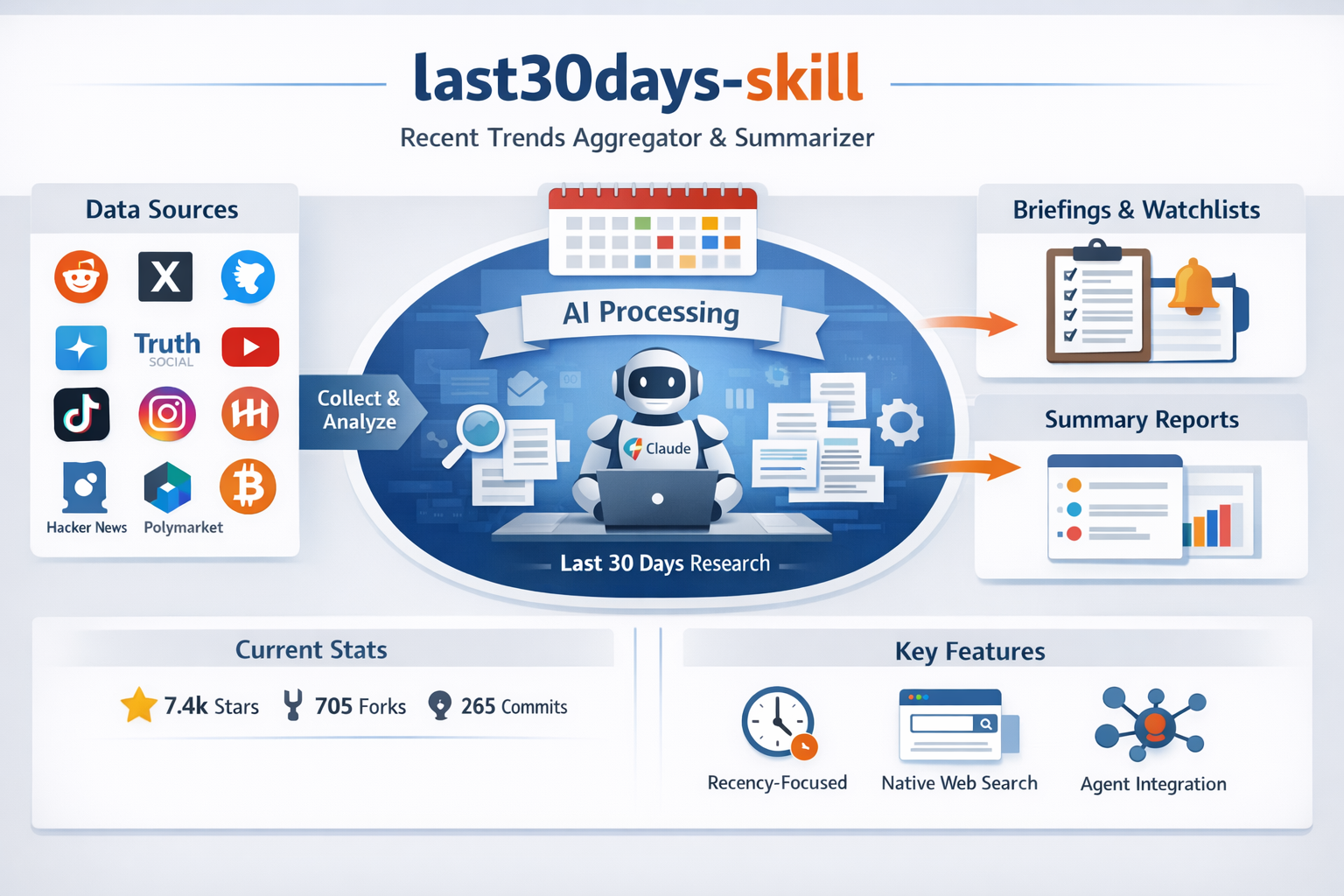
last30days-skill is an AI tool that gathers recent data from multiple online platforms to provide fresh, evidence-based research summaries on trending topics.
Summary
last30days-skill is an open-source AI research tool designed to answer a simple but important question:
What are people actually saying right now?
Instead of relying on old blog posts or stale search results, the project focuses on the last 30 days of discussion across social platforms, video platforms, prediction markets, and the web. It is built as a Claude Code skill, but the bigger story is easy to understand even if you are not a developer: it helps AI produce research that feels more current, more grounded, and more connected to what people are actually discussing online.
For people interested in IT, that makes this project important. It shows how AI tools are moving away from generic answers and toward fresh, evidence-based internet research.
What the Project Is
The repository describes last30days-skill as an AI agent skill that researches any topic across Reddit, X, YouTube, Hacker News, Polymarket, and the web, then synthesizes the results into a grounded summary. The README expands that scope further to include Bluesky, Truth Social, TikTok, and Instagram as well.
In plain English, that means the tool is built to scan recent conversation across multiple online communities, find the strongest signals, and turn them into something useful.
This can be especially valuable for:
- people tracking trends
- founders researching markets
- creators looking for fresh ideas
- marketers trying to understand what is working now
- IT-curious users who want a better way to explore online momentum
The project is not a general-purpose chatbot. It is more like a recency-first research assistant.
Why This Project Matters
A lot of AI tools are impressive, but they often have one weakness: they can sound smart while still being out of date.
That matters more than many people realize. In areas like AI tools, social trends, product buzz, online culture, and community best practices, what worked six months ago may already be irrelevant.
last30days-skill is built around that exact problem. It uses a strict recent window and tries to surface:
- what people are posting
- what communities are upvoting
- what creators are publishing on video
- what technical communities are discussing
- what prediction markets are pricing in
This makes it interesting even for non-developers because it reflects a larger IT trend:
Search is shifting from static pages toward live, multi-source signal gathering.
How It Works in Simple Terms
A beginner-friendly way to understand last30days-skill is to think of it as a three-step pipeline.
1. It gathers recent signals
The tool searches recent discussion from multiple places, including:
- X
- Bluesky
- Truth Social
- YouTube
- TikTok
- Hacker News
- Polymarket
- the web
The idea is not to search everything ever written. The idea is to focus on what is happening now.
2. It scores and filters results
The README explains that results are searched in parallel, then scored, deduplicated, and synthesized. That matters because raw internet data is noisy. A useful research tool has to reduce chaos, not just collect more of it.
3. It turns research into an output you can use
The project can return either:
- a grounded expert-style summary
- or copy-paste-ready prompts for another tool
That is an important difference. It is not just telling you what it found. It is trying to package the findings into something actionable.
Key Features
1. Strict 30-day recency window
The core promise is freshness.
Why it matters:
This makes the tool especially useful for fast-changing topics such as AI tools, pop culture, product launches, trend research, and prompt engineering.
2. Multi-source research
The tool combines signals from social media, video platforms, technical communities, prediction markets, and the broader web.
Why it matters:
This gives a more balanced view than relying on one platform alone.
3. Grounded summaries with citations
The README emphasizes grounded narratives with real citations.
Why it matters:
That makes the output easier to trust and verify.
4. Prompt-generation mode
The project can translate its research into prompts for a target tool.
Why it matters:
This is practical for users who want to turn research directly into workflow output.
5. Watchlists and briefings
The open variant adds watchlists, scheduled topic tracking through external cron-style automation, daily or weekly briefings, and searchable history.
Why it matters:
This turns the project from one-time research into an ongoing monitoring system.
6. Native web-search backends
The open variant supports built-in web-search providers such as Parallel AI, Brave, and OpenRouter.
Why it matters:
It expands the project beyond social discussion into broader web context.
7. Prediction-market integration
One of the standout ideas is Polymarket integration.
Why it matters:
It lets users compare what people are saying with what people are actually betting on.
Why It Is Interesting for People in IT
Even if you are not writing code, this project is still interesting because it points to several bigger technology trends.
AI research is becoming multi-source
The future of useful AI is not just answering from a frozen model. It is combining live signals from many places.
Social proof matters more
Instead of treating every source equally, tools like this try to identify what is actually getting traction, whether through upvotes, reposts, comments, views, or market odds.
Recency is becoming a feature
For many modern topics, freshness is not optional. It is part of the product itself.
AI tools are becoming more specialized
last30days-skill is not trying to do everything. It is specialized around one job: recent, grounded topic research. That focus is part of what makes it useful.
Strengths
- Clear and understandable value proposition
- Strong focus on fresh information
- Broad source coverage
- Useful for both trend discovery and prompt research
- Includes a more advanced “open variant” for ongoing monitoring
- Open-source and actively released, with the latest release shown as v2.9.0 on March 6, 2026
Caveats
A fair report should also mention the tradeoffs.
It is not instant
The README says deeper research can take 2–8 minutes, depending on how niche the topic is.
It depends on external services
Some sources require authentication or API keys, such as X cookies, ScrapeCreators, or optional web-search providers.
It is still operationally messy in places
The repository currently shows multiple open bug reports from March 2026, including Windows compatibility problems, timeout issues, date parsing issues, and a reported SQL injection risk in dynamic kwargs handling.
It is best for “what is happening now”
This is a strength, but also a limitation. If someone wants timeless historical research, this project is not really aimed at that use case.
Practical Use Cases
1. Trend discovery
Find what people are actually discussing about an AI tool, product category, or cultural trend right now.
2. Prompt research
See what techniques are currently working for tools like ChatGPT, Claude, or image generation products.
3. Competitive monitoring
Track competitors, creators, or markets over time with watchlists and briefings.
4. Content planning
Writers, marketers, and creators can use it to find what language, ideas, and examples are gaining traction.
5. Product research
See how a product is being discussed across social media, technical communities, and the web in a single workflow.
Why This Is Good News
The good news about last30days-skill is not just that it is popular on GitHub. The more interesting story is that it solves a real problem in a practical way.
A lot of people do not need more AI that sounds polished. They need AI that is:
- more current
- more grounded
- more connected to real conversation
- more transparent about where its information comes from
This project is a good example of that direction.
Conclusion
last30days-skill is a strong example of where AI-assisted research is heading.
For people interested in IT, the project is valuable because it shows that the next generation of AI tools will not just answer questions from a model alone. They will combine:
- recency
- social signals
- web research
- synthesis
- reusable outputs
In simple terms, this project tries to answer the internet’s messiest question in a smarter way:
What actually matters right now?
That is a useful idea, and it is exactly why last30days-skill is worth paying attention to.