Public note
Hermes Agent: Why This Self-Improving AI Agent Project Matters
Hermes Agent is an open-source self-improving AI agent from Nous Research that learns and remembers across sessions, operates across multiple platforms, and automates tasks.
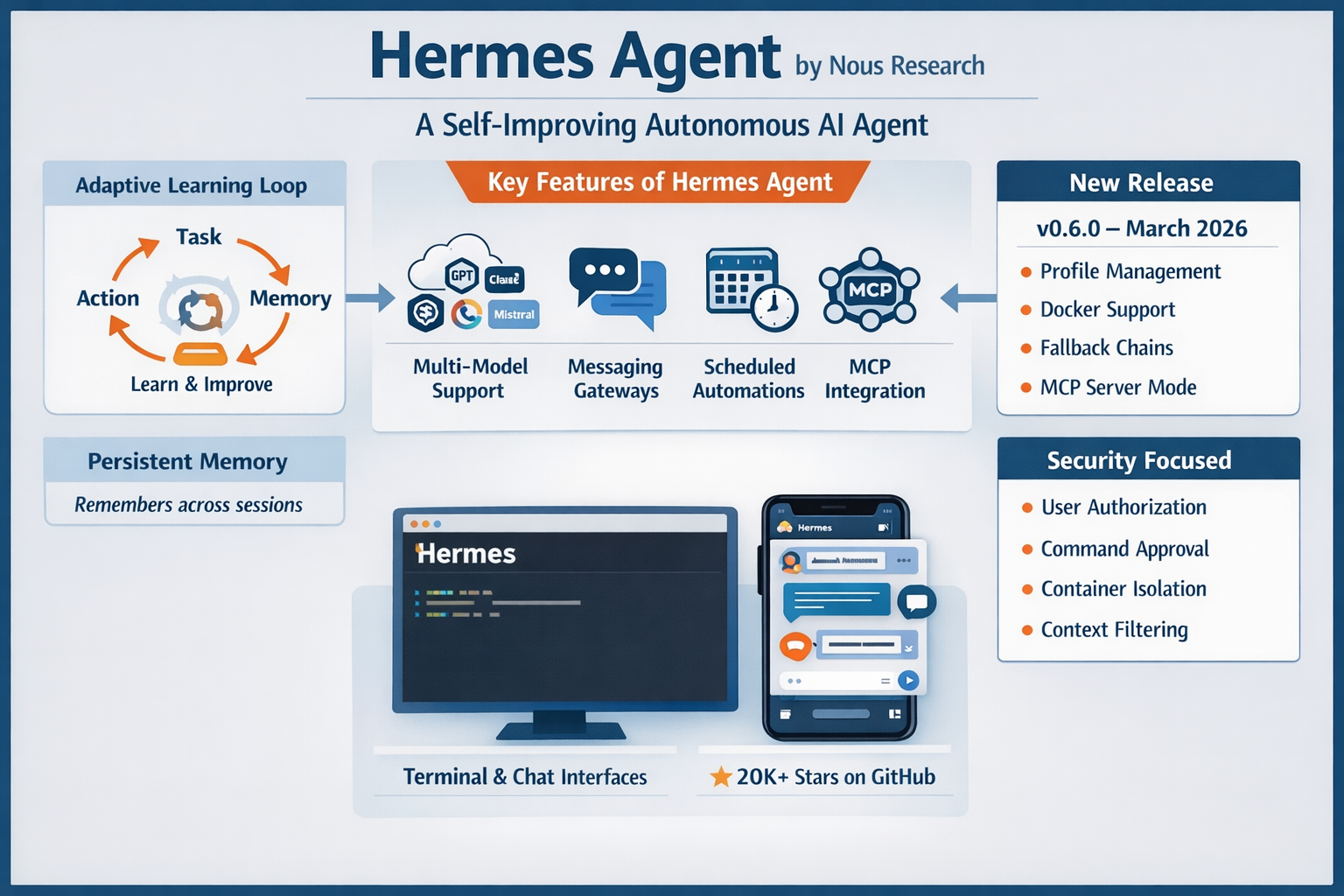
Summary
Hermes Agent is an open-source AI agent project from Nous Research that tries to solve a problem many people already feel with AI assistants: they are often helpful in the moment, but they do not improve much from experience.
Hermes Agent is different because it is built around a self-improving learning loop. The project says it can create skills from experience, improve those skills during use, search its own past conversations, and build a deeper model of the user across sessions. For people interested in IT, the easiest way to understand it is this:
Hermes Agent is an attempt to turn an AI assistant into a persistent, cross-platform, memory-aware digital worker that gets better over time.
That matters because it points to a future where AI is not just reactive chat, but ongoing software that learns, remembers, and works across devices and messaging platforms.
What the Project Is
The GitHub repository describes Hermes Agent as “The self-improving AI agent” and “the agent that grows with you.” That is more than branding. The README frames the project around five core ideas:
- learning from use
- remembering across sessions
- working through multiple interfaces
- running in many different execution environments
- automating tasks on a schedule
In plain English, Hermes Agent is not just another chatbot UI. It is an agent platform that can run in the terminal, connect to messaging apps, call tools, remember what happened before, and keep working in the background.
This makes it relevant to:
- people interested in AI assistants
- IT readers following agent software
- tinkerers who want an assistant beyond a browser tab
- teams exploring automation, messaging bots, and AI workflows
Why Hermes Agent Matters
A lot of AI tools today are still session-based. They answer questions, maybe call a few tools, and then start fresh again later.
Hermes Agent tries to go beyond that model.
The project matters because it combines several important ideas in one system:
- persistent memory
- skill learning
- multi-platform messaging
- scheduled automation
- multiple model providers
- remote or serverless execution
That mix makes Hermes Agent interesting even if you are not a developer, because it reflects a larger shift in IT:
AI assistants are turning into long-running systems, not just short conversations.
How It Works in Simple Terms
A beginner-friendly way to think about Hermes Agent is as a personal AI operator with several layers.
1. You talk to it
You can use Hermes in the terminal or through supported messaging platforms.
2. It uses tools
The agent can work with built-in tools and MCP-connected tools to perform real actions.
3. It remembers
Hermes stores memory, conversation history, and reusable skills so it does not always start from zero.
4. It learns
The project says it can create and refine skills from experience, which is one of its most distinctive ideas.
5. It keeps running
Instead of being tied to your laptop, Hermes can run through Docker, SSH, serverless infrastructure, or remote environments and stay available through messaging apps.
That is why the project feels bigger than a command-line assistant. It is designed to behave more like a durable software system.
Key Features
1. Built-in learning loop
The README says Hermes creates skills from experience, improves them during use, and nudges itself to preserve useful knowledge.
Why it matters:
Most assistants answer and forget. Hermes is trying to accumulate capability over time.
2. Cross-session memory
Hermes supports memory, user profiles, and searchable session history.
Why it matters:
This makes the assistant more personal and more consistent.
3. Works across many interfaces
The docs say Hermes supports a terminal UI plus messaging through Telegram, Discord, Slack, WhatsApp, Signal, SMS, Email, Home Assistant, Mattermost, Matrix, DingTalk, Feishu/Lark, and WeCom.
Why it matters:
It lets one agent follow the user across many different places instead of staying trapped in one app.
4. Works with many model providers
The README and FAQ say Hermes works with Nous Portal, OpenRouter, OpenAI-compatible endpoints, local models, and others such as GLM, Kimi/Moonshot, and MiniMax.
Why it matters:
This lowers lock-in and lets users switch providers without redesigning the whole workflow.
5. MCP integration
Hermes can connect to MCP servers to extend its toolset.
Why it matters:
This helps it reach external systems without rebuilding everything into Hermes core.
6. Scheduled automations
The project includes a built-in cron scheduler and can deliver results back to connected platforms.
Why it matters:
It shifts the tool from “answer on demand” to “work continuously in the background.”
7. Multiple execution backends
The README says Hermes supports local, Docker, SSH, Daytona, Singularity, and Modal terminal backends.
Why it matters:
This makes the project much more flexible than an assistant tied to one machine.
8. Security model
The security docs describe layers such as user authorization, dangerous command approval, container isolation, MCP credential filtering, and context-file scanning.
Why it matters:
Agent software becomes much more useful when it can act, but also much more risky. Security design is therefore a major part of the product story.
9. Voice mode
The docs also include voice interaction for CLI and messaging workflows.
Why it matters:
It points toward a more natural interface for long-running agents.
What Makes Hermes Agent Different
The most important thing that makes Hermes Agent stand out is not just that it has tools or memory. Many projects now claim that.
The distinctive idea is that Hermes is built as a closed learning loop. The README emphasizes:
- skill creation after complex tasks
- self-improving skills during use
- FTS5 session search with LLM summarization
- a deeper model of the user across sessions
That means Hermes is trying to become not just a tool-using assistant, but an assistant that develops habits and procedures.
This is a major idea in modern AI software. It shifts the product from a model wrapper to a form of accumulated operational intelligence.
Why It Is Interesting for People in IT
Even if you never install Hermes Agent, it is still worth paying attention to because it captures several bigger trends.
AI is becoming persistent
The future of useful assistants is likely to involve memory, profiles, and ongoing context.
Messaging is becoming an AI interface
Hermes treats Telegram, Discord, Slack, WhatsApp, and other channels as first-class surfaces for agent interaction.
Agents are becoming infrastructure
Instead of living only in a chat window, agents are becoming gateways, schedulers, tool routers, and automation systems.
Learning from use is becoming a differentiator
The next generation of AI products may compete less on one-shot intelligence and more on how well they improve from repeated work.
Security is becoming central
As agents gain more power, their security boundaries matter as much as their reasoning.
Strengths
- Clear and ambitious vision
- Strong differentiation through self-improvement and skills
- Cross-platform design is unusually broad
- Flexible model-provider support reduces lock-in
- Built-in automation makes it more practical than chat-only tools
- Security is taken seriously in the docs and architecture
- Strong open-source traction suggests real community interest
Caveats
A balanced report should mention the tradeoffs too.
1. It is still a technical tool
Although the install is simplified, Hermes Agent is still more complex than a casual consumer AI app.
2. Native Windows is not supported
The quickstart and FAQ say Windows users should install WSL2 rather than run Hermes natively.
3. Broad capability means broad complexity
A system that spans CLI, messaging platforms, MCP tools, schedulers, backends, and memory can do a lot, but that also means more setup and operational complexity.
4. Self-improvement is powerful but harder to evaluate
The learning-loop idea is one of the most interesting parts of Hermes, but it is also something users will judge over time rather than instantly.
Current Momentum
Hermes Agent has strong public momentum on GitHub. At the time of writing, the repository shows roughly:
- 20.1k–20.2k stars
- 2.4k forks
- 3,013 commits
The current latest release on GitHub is Hermes Agent v0.6.0 (v2026.3.30), published on March 30, 2026. The release highlights include:
- profiles for isolated multi-instance setups
- MCP server mode
- an official Docker container
- fallback provider chains
- support for Feishu/Lark and WeCom
- Telegram webhook mode
- Slack multi-workspace OAuth
That pace of development suggests the project is evolving quickly.
Why This Project Is Good News
The good news about Hermes Agent is not just that it is popular. The bigger story is that it pushes AI assistants toward a more useful form.
For IT readers, Hermes Agent shows that the future of AI may look like this:
- one agent across many platforms
- one conversation history across many sessions
- automation that runs without constant supervision
- memory that gets reused instead of lost
- skills that improve rather than staying static
That is a meaningful step beyond ordinary chatbot software.
Conclusion
Hermes Agent is best understood as a persistent, self-improving AI agent system rather than a simple assistant.
In the simplest possible terms:
It tries to become an AI helper that remembers, learns, automates, and follows you across platforms.
That makes it relevant not only to developers, but to anyone trying to understand where AI assistants are heading next.
Hermes Agent is impressive because of what it combines.
It is important because it shows what a more durable, cross-platform, learning-oriented AI future might look like.