Public note
Godot Engine Shows the Scale — and Burden — of an Open-Source Game Engine
Godot Engine, a full-fledged open-source game development platform under the MIT license, recently released version 4.6.3 with significant bug fixes and stability improvements.
Subheadline
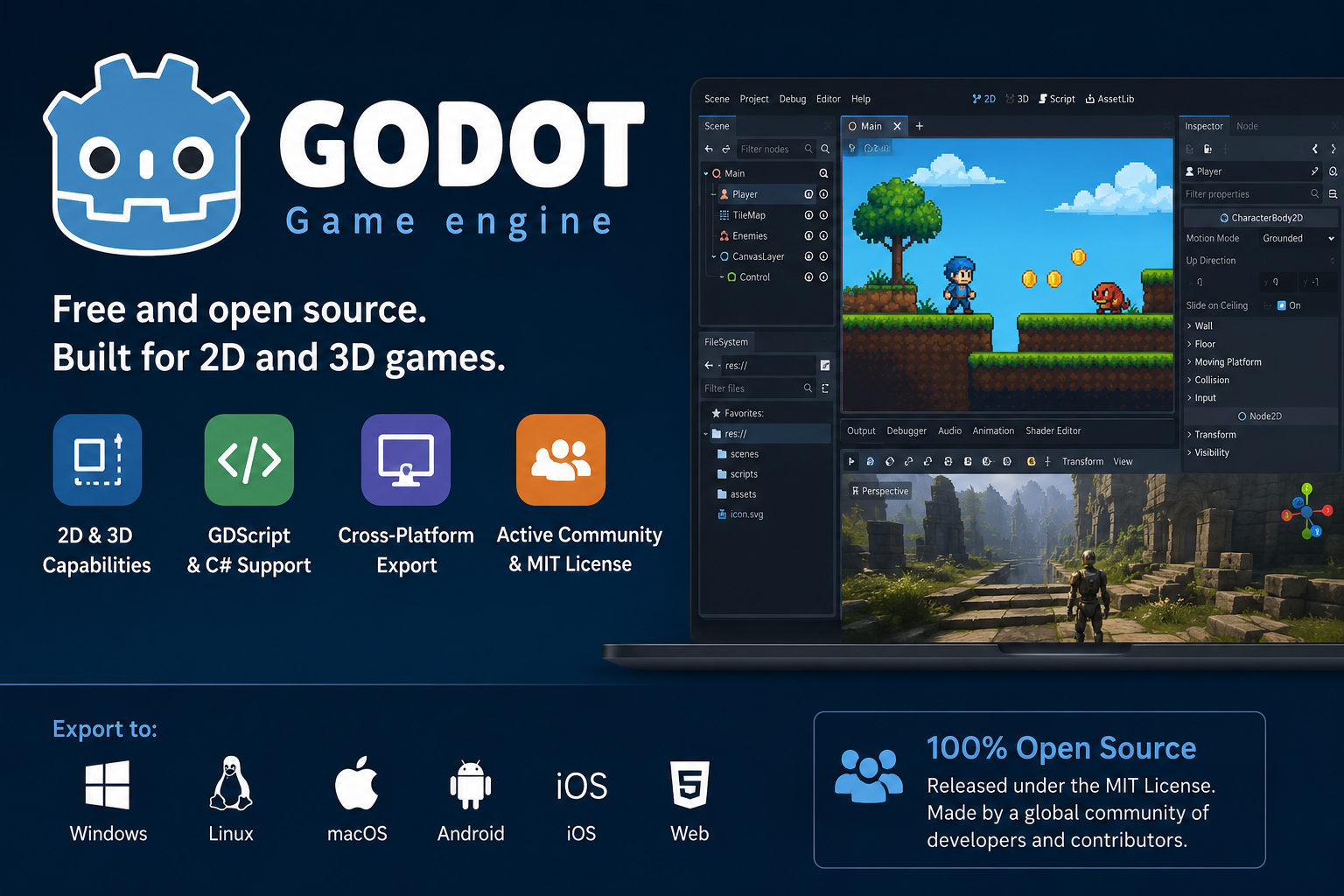
The godotengine/godot repository is the source code home for Godot Engine, a free, MIT-licensed 2D and 3D game engine backed by the Godot Foundation and maintained through a large community process.
Lead
Godot Engine is not a small developer tool or a single-purpose framework. The repository at github.com/godotengine/godot is the main source tree for a full cross-platform game engine: editor, runtime, rendering systems, platform exporters, documentation hooks, tests, modules, and the infrastructure needed to ship a production engine.
The project’s own identity is explicit: Godot is a “2D and 3D cross-platform game engine,” designed to let developers create games from a unified interface and export them to desktop, mobile, web, and console targets through supported workflows and third-party console publishers.
At a Glance
- Project: Godot Engine
- Repository:
godotengine/godot - Owner / organization: Godot Engine project, supported by the Godot Foundation
- Primary purpose: Free, open-source 2D and 3D game development
- License: MIT
- Latest stable release observed: Godot 4.6.3-stable, released May 20, 2026
- Repository scale observed: About 112,000 GitHub stars, 25,600 forks, and 83,983 commits at the time the repository page was fetched
- Primary implementation language shown by GitHub: C++ dominates the repository language breakdown
What Happened
The most recent stable release visible from the repository is Godot 4.6.3-stable, published on May 20, 2026. The GitHub release describes it as a maintenance release focused on stability, usability, and bug fixes, and recommends adoption because maintenance releases are intended to be compatible with earlier releases in the same line.
Godot’s own release article gives the clearest detail: 41 contributors submitted 86 fixes for Godot 4.6.3, and the release was built from commit 35e80b3a8. The listed changes cover a broad set of engine areas, including 2D, 3D, animation, build system updates, C#, Android, editor behavior, iOS export, GUI text handling, input, physics, and rendering.
The release article also states that, at publication, there were no known incompatibilities with Godot 4.6.2, while still advising users to back up projects or use version control before upgrading.
Key Facts / Comparison
| Area | Source-grounded fact |
|---|---|
| Engine type | Cross-platform 2D and 3D game engine |
| Licensing | Free and open source under the MIT license |
| Governance / support | Supported by the Godot Foundation not-for-profit |
| Export targets | Desktop, mobile, web, and consoles through the project’s documented export model |
| Scripting / extension options | GDScript, C#, C++, GDExtension, and community-supported language bindings are described on the official site |
| Latest stable release observed | 4.6.3-stable, May 20, 2026 |
| Latest maintenance release scope | 86 fixes from 41 contributors |
| Repository language profile | GitHub reports C++ as the dominant language, followed by C#, Java, C, GLSL, Objective-C++, and others |
Background and Context
Godot’s README frames the project as a feature-packed engine for creating 2D and 3D games from one interface. It says the engine provides common tools so developers can focus on game creation rather than rebuilding core engine systems.
The same README emphasizes the project’s free and open-source model. Godot is distributed under the MIT license, with no royalties or ownership strings attached to games made with it. The README also says Godot’s development is independent and community-driven, and that the project is supported by the Godot Foundation.
The project has a longer history than its GitHub-era public identity. The README states that before Godot was open sourced in February 2014, Juan Linietsky and Ariel Manzur had developed it for several years as an in-house engine used to publish work-for-hire titles.
Why This Matters
For game developers, Godot’s proposition is not just that it is free. Its strategic significance comes from combining a full editor, 2D and 3D workflows, multiple scripting paths, cross-platform exports, and open-source licensing.
That combination changes the trade-off for small studios, educators, hobbyists, and teams that want engine source access. The MIT license lowers legal and commercial friction. The open repository lets developers inspect behavior, patch problems, or build custom engine variants. The active maintenance release cadence also matters because game engines are long-lived dependencies: projects can remain in production for years, and bug-fix releases are often more important than headline features.
Insight and Industry Analysis
Godot’s public materials show a project trying to balance two difficult roles: accessible game-making tool and serious engine platform. Its feature page emphasizes a node-and-scene design model, GDScript for approachable scripting, C# for developers already invested in .NET, and GDExtension/C++ for lower-level performance or engine integration work.
That flexibility is a strength, but it also expands the maintenance surface. A release like 4.6.3 illustrates the challenge: even a maintenance update touches rendering, GUI, physics, Android, iOS export, C#, editor behavior, and core threading-related code. For users, this breadth is useful. For maintainers, it means stability depends on a distributed contributor model, careful regression handling, and a strong issue-reporting culture.
The project’s GitHub footprint — more than 100,000 stars, tens of thousands of forks, and thousands of open issues and pull requests shown on the repository page — indicates broad developer attention. It also signals coordination pressure: a popular open-source engine must triage community needs while still protecting compatibility and release quality.
Strengths, Limitations, and Open Questions
Strengths
- Free and MIT-licensed, with the source code available for inspection and modification.
- Unified 2D and 3D editor workflow.
- Multiple programming routes: GDScript, C#, C++, GDExtension, and community-supported bindings.
- Cross-platform deployment focus across desktop, mobile, web, XR, and console routes.
- Active maintenance releases, with Godot 4.6.3 addressing 86 fixes.
Limitations
- The repository page shows thousands of issues and pull requests, which suggests a large backlog and heavy maintainer workload.
- Official materials note that C# support has platform limits: as of Godot 4.2, C# support is available for desktop and mobile platforms, while Godot 3 remains a supported option for C# on web.
- Console support is not presented as a direct open download path; the official site points developers toward third-party publishers for console targets.
Open questions
- The sources do not provide benchmark comparisons against other engines.
- The sources do not quantify commercial adoption beyond examples and showcase references.
- The sources do not give a detailed long-term roadmap in the pages reviewed here, beyond current releases and priorities links.
Technical Deep Dive
The repository layout reflects a large native engine codebase rather than a library wrapper. Visible top-level directories include core, drivers, editor, main, modules, platform, scene, servers, tests, and thirdparty. That structure suggests separation between engine foundations, platform-specific code, editor systems, runtime scene abstractions, servers, optional modules, and bundled third-party components.
Godot’s official feature page describes the engine’s design around nodes and scenes. Developers combine nodes into reusable scenes, attach scripts, and build game logic through composition and hierarchy. The same page describes custom resources for data-driven elements and engine-level APIs for storing and reading those resources.
On the language side, Godot positions GDScript as its high-level built-in scripting language, inspired by Python and other languages, with optional static typing. C# is offered through a dedicated .NET engine executable, while C++ extension is officially exposed through GDExtension for high-performance components without recompiling the engine. The official site also notes community-supported bindings for languages such as Rust, Nim, Python, and JavaScript.
Rendering and platform support are similarly broad. The features page describes 3D support for a range of devices, mentions OpenGL, Vulkan, Direct3D 12, and Metal renderers, and describes 2D as a dedicated pipeline with pixel-based coordinates and 2D nodes. It also states that OpenXR and WebXR support are built into the engine, with additional XR SDK support available through community-maintained plugins.
What to Watch Next
The immediate release signal is the split between Godot 4.6.3 as the stable maintenance line and Godot 4.7 beta development visible on the official homepage. For production users, 4.6.3 matters because it is framed as a safe maintenance upgrade. For developers tracking future features, the 4.7 beta series is the next line to monitor.
The areas to watch are compatibility notes, rendering changes, mobile and web export behavior, C# platform coverage, and the evolution of the Godot Asset Store and Android/XR editor work mentioned in recent official news posts.
Conclusion
The godotengine/godot repository represents one of open source’s most ambitious creative software projects: a full 2D and 3D game engine with editor, runtime, export tooling, scripting systems, rendering backends, and a large contributor base.
The clearest current news peg is Godot 4.6.3, a maintenance release with 86 fixes from 41 contributors. But the broader story is the project’s operating model: Godot is a free MIT-licensed engine that asks its community not just to use the tool, but to help shape and maintain it.