Public note
GitNexus Wants to Become the Missing Context Layer for AI Coding Agents
GitNexus is a code intelligence engine that transforms repositories into local knowledge graphs, aiding both human developers and AI coding agents through browser-based visualization and CLI tools with MCP integration.
Subheadline
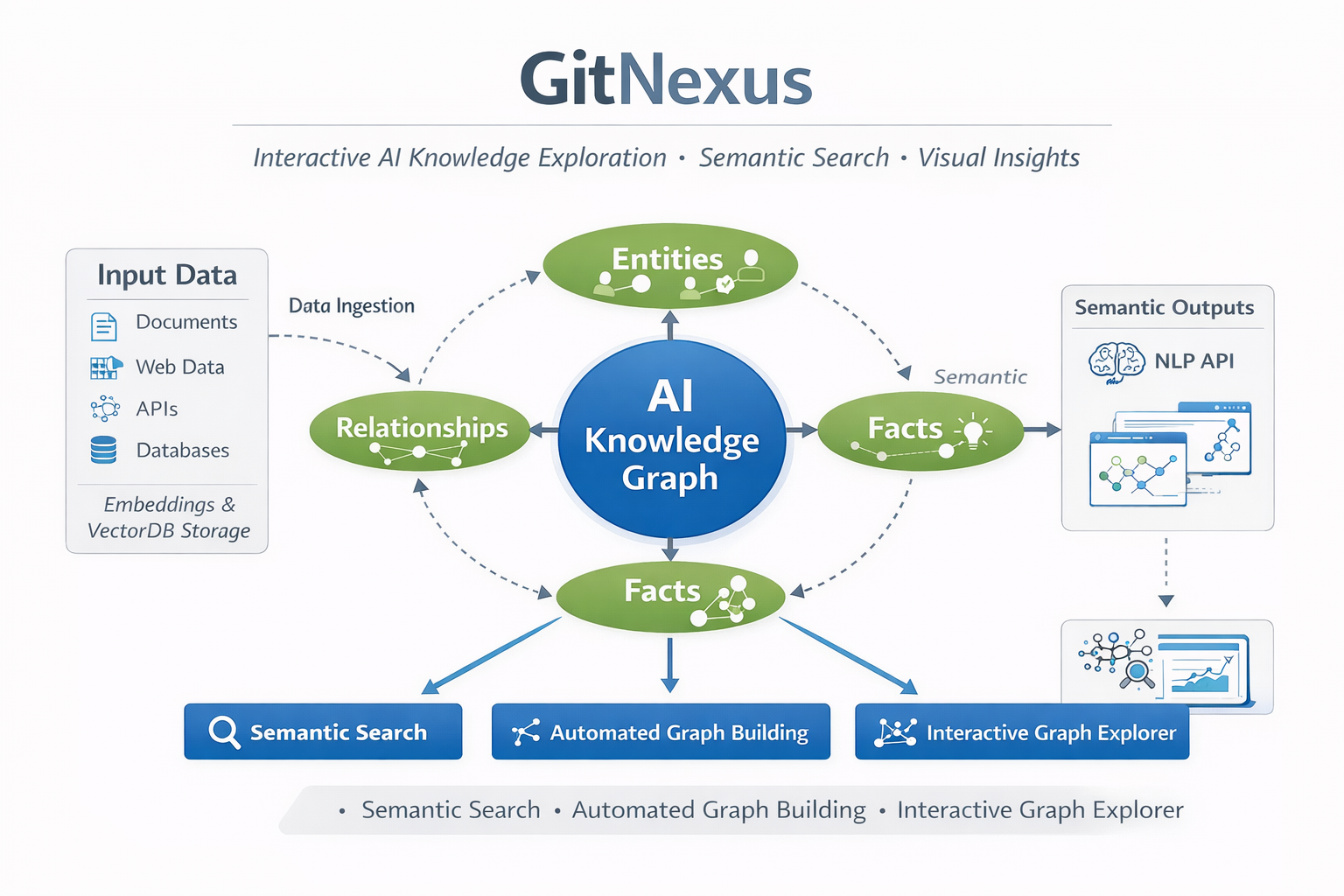
GitNexus is pitching itself as a zero-server code intelligence engine that turns repositories into local knowledge graphs for both humans and AI agents. The project’s mix of browser-native analysis, CLI tooling, and MCP integration makes it stand out in a crowded market—but its noncommercial license also shapes how far the open-source story really goes.
Lead
AI coding tools have become remarkably good at generating code, but they still struggle with something more basic: understanding a large codebase as a system rather than a pile of files. That is the problem GitNexus is trying to solve.
The project, created by Abhigyan Patwari, indexes a repository into a knowledge graph that tracks relationships such as dependencies, call chains, inheritance, execution flows, and functional clusters. Instead of asking a model to infer architecture from raw text or search snippets, GitNexus gives it a structured map of the code. In practice, that means developers can inspect a repository visually in the browser, or connect the graph to tools such as Claude Code, Cursor, Codex, and Windsurf through the Model Context Protocol, or MCP.
That pitch is resonating. On April 7, 2026, the GitHub repository showed roughly 23.8k stars, 2.7k forks, and 58 contributors, a notable signal for a project that sits at the intersection of code intelligence, local-first developer tooling, and the AI agent boom.
At a Glance
- GitNexus turns source code into a local knowledge graph designed for both code exploration and AI-agent context.
- The project offers two product paths: a browser-based web UI and a CLI plus MCP workflow for editor and agent integrations.
- GitNexus says both modes are local-first: the CLI keeps indexing on the user’s machine, while the web UI runs in-browser with WebAssembly.
- Supported language coverage spans 14 languages in the current README, including TypeScript, Python, Java, C#, Go, Rust, PHP, Ruby, Swift, C, C++, and Dart.
- Recent releases show the project is moving quickly, with version 1.5.3 released on April 1, 2026, and an unreleased migration from KuzuDB to LadybugDB already documented in the changelog.
- Despite its popularity, the repository is not under a permissive OSS license; it uses PolyForm Noncommercial 1.0.0, while commercial and enterprise use are routed to separate offerings.
What Happened
GitNexus has emerged as one of a growing number of tools trying to make AI coding assistants less error-prone by giving them structured context. Its core promise is straightforward: index a codebase once, build a graph of how the software actually fits together, and then expose that graph through search, impact analysis, symbol context, change detection, and rename operations.
The project now spans more than a demo or research prototype. The repository’s architecture documents describe a monorepo with two main products: a CLI/MCP package for production-style development workflows and a separate web application for browser-based graph exploration. The CLI can analyze repositories, register them globally, serve MCP tools to compatible editors and agents, and expose an HTTP bridge for the web interface. The browser UI, by contrast, targets quick exploration and visual chat-driven analysis without a local install.
The project is also moving fast. The changelog shows a steady cadence of feature work across language support, type resolution, graph construction, and publishing fixes, while the latest published release on GitHub is version 1.5.3 dated April 1, 2026.
Key Facts / Comparison
| Area | Web UI | CLI + MCP |
|---|---|---|
| Primary use case | Quick exploration, demos, one-off analysis | Daily development and AI-agent workflows |
| Installation | No install; browser-based | npm install -g gitnexus |
| Scale | Browser-memory limited, around ~5k files unless using backend mode | Full repositories, any size |
| Storage | LadybugDB WASM, in-memory per session | Native LadybugDB, persistent local storage |
| Parsing | Tree-sitter WASM | Native Tree-sitter bindings |
| Privacy model | In-browser, no server upload | Local machine, no network during indexing |
| Agent integration | Built-in graph chat and visual exploration | MCP server for Claude Code, Cursor, Codex, Windsurf, OpenCode |
Notable built-in MCP tools
query: natural-language and keyword search over the graphcontext: callers, callees, and process-level view for a symbolimpact: upstream and downstream blast-radius analysisdetect_changes: maps git diffs to affected symbols and processesrename: graph-assisted rename with preview supportlist_reposandcypher: multi-repo discovery and ad hoc graph queries
Background and Context
GitNexus arrives at a moment when AI-assisted coding has shifted from autocomplete to semi-autonomous editing. That change has created a new bottleneck. Large language models can generate patches quickly, but they often miss hidden dependencies, misunderstand code ownership, or refactor one part of a system while breaking another. The more autonomous the agent, the more dangerous those blind spots become.
GitNexus’s answer is to make architecture machine-readable. Its ingestion pipeline parses repositories with Tree-sitter, resolves imports and call relationships, detects communities and execution flows, and stores the result in a graph database under a local .gitnexus/ directory. The MCP server then lets external coding agents query that graph instead of relying entirely on raw file retrieval.
This is also why the project’s messaging focuses so heavily on “agent context” and “blast radius.” GitNexus is not merely another repo visualization layer. It is trying to become a reliability layer for AI coding systems.
Why This Matters
The appeal of GitNexus is that it speaks to three different audiences at once.
For individual developers, it promises a faster way to understand unfamiliar repositories and trace how symbols, services, and processes connect.
For teams using AI agents in production workflows, it offers a way to reduce context loss. Graph-backed queries, impact analysis, and change mapping are all attempts to make AI coding less brittle.
For enterprises, the project points toward something larger: a local-first or self-hosted context layer that could sit between proprietary codebases and increasingly capable coding agents.
The stakeholders most affected
- Developers: better architectural visibility for onboarding, debugging, and refactoring
- AI-agent users: more reliable tool context than plain file search or embeddings alone
- Security- and privacy-sensitive teams: a local-first option that avoids sending source code to a remote indexing service
- Commercial adopters: a reminder that licensing matters, because GitNexus’s repository license is noncommercial rather than permissive
Insight and Industry Analysis
GitNexus is interesting not because it invented the idea of code graphs, but because it packages several trends into one coherent product.
First, it leans into the MCP ecosystem at exactly the moment developers are looking for ways to make Claude Code, Cursor, Codex, and similar systems more grounded. Second, it treats local execution and privacy not as optional features but as core product positioning. Third, it recognizes that code understanding is becoming infrastructure: whoever controls the context layer increasingly shapes what an AI coding agent can do well.
That said, GitNexus is also making a tradeoff. A browser-based architecture is attractive for privacy and simplicity, but it comes with memory limits. The project itself acknowledges that the web UI is constrained to roughly 5,000 files unless a backend mode is used. For bigger repositories, the CLI path is clearly the serious option.
The licensing model is another strategic signal. PolyForm Noncommercial 1.0.0 makes the code visible and usable for noncommercial purposes, but it is not the same as permissive open source in the usual enterprise adoption sense. GitNexus appears to be following a familiar playbook in AI infrastructure: build momentum in public, then monetize through commercial licensing, SaaS, and self-hosted enterprise packages.
Pros and Cons
Pros
- Strong product fit for the AI-agent era: the project is designed around architectural context, not just code search.
- Local-first privacy model: both the CLI and browser story emphasize keeping source code off remote servers.
- Clear dual-product strategy: the web UI is easy to try, while the CLI plus MCP path is built for real workflows.
- Broad language ambition: 14-language support is already documented, with recent releases expanding resolution quality and ecosystem coverage.
- Useful operational tooling: impact analysis, diff-aware change detection, and rename preview are practical features, not just flashy demos.
Cons
- Web UI limitations remain real: large repositories will still push users toward the CLI or backend-assisted modes.
- License friction for companies: PolyForm Noncommercial is a meaningful constraint for commercial users evaluating adoption.
- Rapid pace can mean moving parts: changelog activity is a sign of momentum, but also of a product still hardening quickly.
- Editor integration depth is uneven: the README explicitly gives Claude Code the deepest integration, with other tools receiving different levels of support.
Technical Deep Dive
GitNexus is built as a monorepo with a relatively clean split between graph generation and graph consumption.
Core architecture flow
- Ingestion:
gitnexus analyzewalks the repository, parses supported languages with Tree-sitter, resolves relationships, detects communities and execution flows, and builds an in-memory graph. - Persistence: the graph is stored in LadybugDB under the repository’s local
.gitnexus/directory, alongside metadata and optional search or embedding indexes. - Registry: indexed repositories are registered globally in
~/.gitnexus/registry.json, which lets one MCP server serve more than one repo. - Serving: GitNexus can expose the graph through a stdio MCP server for editors and agents, or via a local HTTP bridge for the browser UI.
- Staleness checks: the system compares indexed commits to current git state and warns when the graph is behind the repository head.
Supported language matrix
| Language | Imports | Exports | Heritage | Type Annotations | Constructor Inference | Framework Detection | Entry Points |
|---|---|---|---|---|---|---|---|
| TypeScript | Yes | Yes | Yes | Yes | Yes | Yes | Yes |
| JavaScript | Yes | Yes | Yes | No | Yes | Yes | Yes |
| Python | Yes | Yes | Yes | Yes | Yes | Yes | Yes |
| Java | Yes | Yes | Yes | Yes | Yes | Yes | Yes |
| Kotlin | Yes | Yes | Yes | Yes | Yes | Yes | Yes |
| C# | Yes | Yes | Yes | Yes | Yes | Yes | Yes |
| Go | Yes | Yes | Yes | Yes | Yes | Yes | Yes |
| Rust | Yes | Yes | Yes | Yes | Yes | Yes | Yes |
| PHP | Yes | Yes | No | Yes | Yes | Yes | Yes |
| Ruby | No named bindings | Yes | Yes | No | Yes | Yes | Yes |
| Swift | No imports/named bindings in README table | Yes | Yes | Yes | Yes | Yes | Yes |
| C | No imports/named bindings in README table | Yes | No | Yes | Yes | Yes | Yes |
| C++ | No imports/named bindings in README table | Yes | Yes | Yes | Yes | Yes | Yes |
| Dart | Yes | Yes | Yes | Yes | Yes | Yes | Yes |
Under-the-hood components
- Tree-sitter: language parsing and AST extraction
- LadybugDB: embedded graph store with vector support, replacing earlier KuzuDB usage
- Graphology and Sigma.js: graph structures and browser visualization
- transformers.js: browser-side embedding and ML support where enabled
- React + Vite + Tailwind: frontend stack for the web application
A notable recent engineering shift
The project’s unreleased changelog already documents an internal migration from KuzuDB to LadybugDB v0.15, including storage-path changes from .gitnexus/kuzu to .gitnexus/lbug. That matters because it suggests GitNexus is still optimizing the graph layer underneath the product even as it expands features on top.
What to Watch Next
- Whether GitNexus can turn its fast GitHub momentum into durable developer adoption inside real editor workflows
- How much the browser-first experience can scale before users default almost entirely to the CLI path
- Whether the enterprise offering becomes the main commercial vehicle for larger teams and regulated environments
- How quickly upcoming roadmap items such as incremental indexing and LLM-based cluster enrichment ship
- Whether the project’s noncommercial licensing limits broader platform integrations despite strong community interest
Conclusion
GitNexus is one of the more compelling infrastructure projects to emerge from the AI coding wave because it focuses on a problem many rivals still treat as secondary: context integrity. By turning repositories into knowledge graphs and exposing that structure through search, analysis, and MCP tooling, it offers a practical answer to the “AI broke my codebase” problem.
Its biggest strengths are also its defining tensions. The local-first design is attractive, but the web path has limits. The public repository has strong momentum, but the license is not conventionally open for commercial adoption. And the product vision is ambitious, which means execution quality will matter more with every release. Still, for developers and teams looking for a serious context layer beneath AI coding agents, GitNexus is clearly a project worth watching.