Public note
FinceptTerminal Is Building an Open-Source Native Finance Workstation
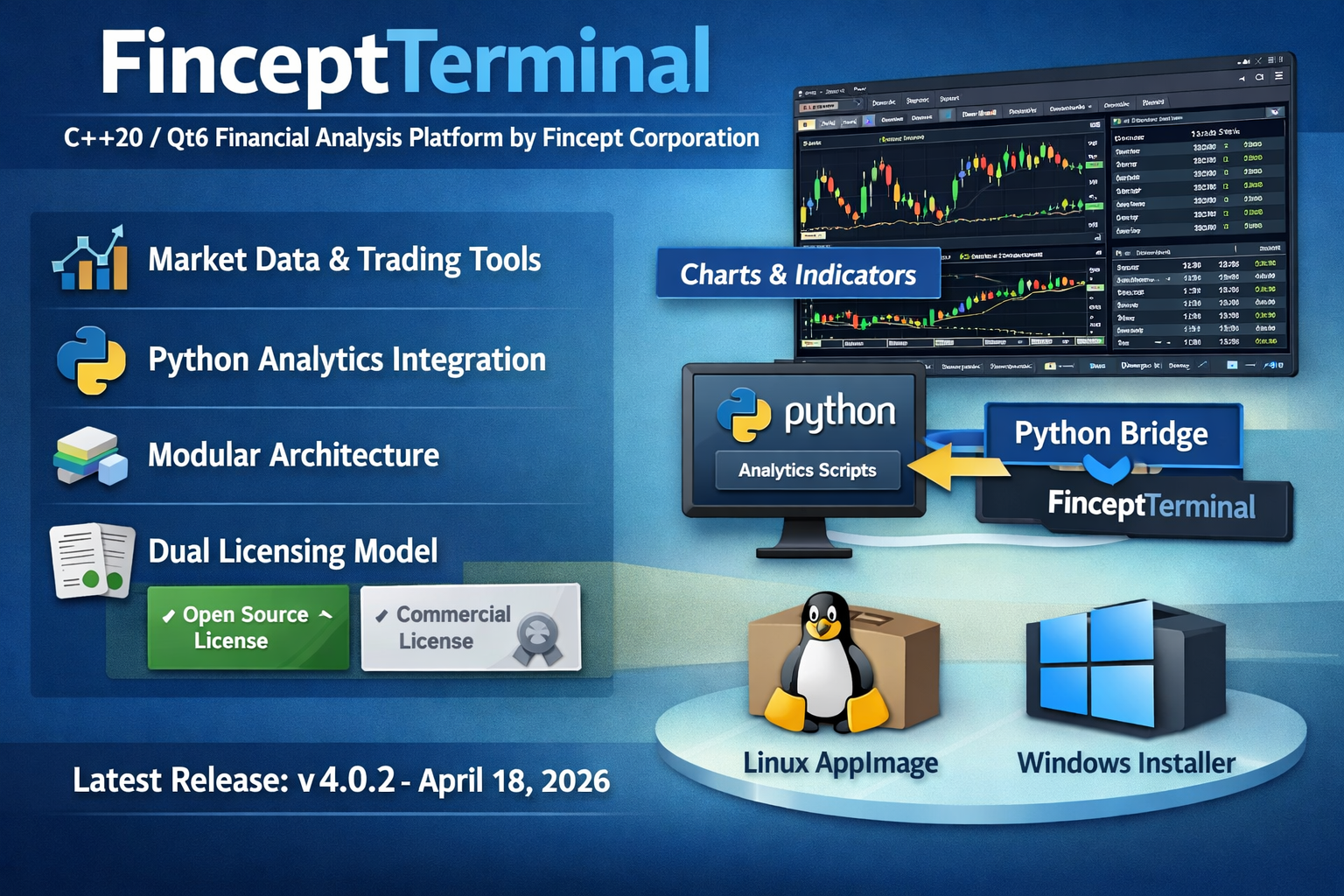
FinceptTerminal is a comprehensive open-source financial analysis platform developed by Fincept Corporation, offering native desktop applications with extensive features including market data, trading workflows, AI tools, and Python analytics integration.
Subheadline
The Fincept-Corporation repository describes FinceptTerminal as a native C++20 desktop financial analysis platform with embedded Python analytics, trading integrations, AI tooling, and broad data connectivity. The public materials show an ambitious scope, but they also leave important questions open around benchmarking, data rights, and how much of the platform depends on commercial services.
Lead
FinceptTerminal is not a lightweight stock tracker or a browser-wrapped dashboard. In the project’s own materials, it is presented as a native desktop financial terminal by Fincept Corporation, built with C++20 and Qt6, with Python used as an analytics bridge. The repository combines market data, news, equity research, trading workflows, AI-oriented features, and a visual node editor into a single product surface.
That breadth is what makes the project notable. Open-source finance tools often go deep in one direction—charting, backtesting, screening, or broker access. FinceptTerminal tries to do several of those jobs at once, and to package them in a cross-platform desktop application rather than a web-first stack.
The immediate news peg is modest but real: the repository’s README points to version 4.0.2 as the current release, and the release page shows the v4.0.2 tag dated April 18, 2026. Beyond that release marker, this is best understood as a project analysis rather than a breaking-news launch story.
At a Glance
- Project: FinceptTerminal
- Owner: Fincept Corporation
- What it is: A native desktop financial analysis platform
- Primary purpose: Market analytics, research, trading workflows, and economic-data exploration
- Core stack: C++20, Qt6, Python
- Distribution: Windows x64, Linux x64, macOS Apple Silicon installers, plus Docker and source builds
- License model: AGPL-3.0 plus commercial licensing
- Latest tagged release in the provided sources: v4.0.2
What Happened
The repository presents Fincept Terminal v4 as a substantial rewrite or maturation point around a native desktop architecture. The README describes the product as a “pure native C++20 desktop application” using Qt6 for interface and rendering, with embedded Python for analytics. The official architecture document reinforces that positioning with a layered system design spanning Qt UI, application services, trading, MCP integration, storage, networking, and a Python bridge.
The official website broadens that pitch. It markets FinceptTerminal as “Financial Terminal Redefined,” highlights real-time market data, AI-assisted research, charting, and economic intelligence, and explicitly frames the product as a lower-cost alternative to premium finance terminals. That framing is central to the project’s identity, but it should still be treated as product positioning rather than independent validation.
Key Facts / Comparison
| Dimension | What the sources support |
|---|---|
| Product identity | FinceptTerminal is a financial analysis platform by Fincept Corporation |
| Primary form factor | Native desktop application |
| Main technologies | C++20, Qt6, Python 3.11+ |
| Architecture style | Layered desktop architecture with UI, application, infrastructure, and platform layers |
| Analytics model | UI and services in C++ with Python scripts returning JSON back into the app |
| Data/trading scope | The README claims 100+ data connectors, real-time trading support, paper trading, and multiple broker integrations |
| AI scope | The README claims 37 AI agents and MCP tool integration |
| Packaging | Installers for Windows, Linux, and macOS, plus Docker and manual builds |
| License | Dual-licensed: AGPL-3.0 and commercial |
| Current release peg | v4.0.2 tagged on April 18, 2026 |
Background and Context
FinceptTerminal sits in an interesting middle ground between open-source software and productized financial infrastructure. The repository is public, the code is positioned as open source, and the app can be built locally. At the same time, the project’s own materials also reference commercial licensing, commercial access to Fincept Data and APIs, university licensing, and a broader company website with pricing and demo flows.
That matters because the project is not simply “a GitHub app.” It appears to be the codebase for one layer of a broader product strategy. The official site includes both Download Desktop and Launch Web Terminal paths, while the repository itself is centered on the desktop application. In other words, the repo is open and technically detailed, but it likely does not represent the full commercial surface of Fincept’s offering.
Why This Matters
The technical choice here is important. Many modern finance platforms lean on web technologies for portability and faster iteration. FinceptTerminal instead emphasizes native rendering, single-binary delivery, local storage, and Qt-based UI composition.
That choice can matter in several ways:
- Performance and responsiveness: A compiled desktop stack can reduce browser overhead and support heavier UI workloads.
- Local integration: SQLite, native credential storage, and direct process execution for Python scripts fit naturally into a desktop model.
- Tool breadth: Combining charting, trading, research, news, and AI in one app can be more compelling in finance than scattering them across browser tabs.
- Developer complexity: The tradeoff is higher build discipline, pinned dependencies, and tougher cross-platform maintenance.
Insight and Industry Analysis
FinceptTerminal’s most interesting design decision is not any single feature. It is the hybrid between a compiled native shell and a script-driven analytics engine.
The architecture document shows a very deliberate split: screens render the UI, services handle fetching and processing, and Python scripts can be spawned for analytics workloads that return JSON into the C++ application. That is a pragmatic design for a finance terminal. It lets the project keep a high-performance native interface while still tapping into Python’s finance and data ecosystem.
There is also a strategic bet here. Rather than specializing narrowly in charting, quant research, or brokerage access, FinceptTerminal is trying to become a workstation. The repository’s feature list spans DCF modeling, risk metrics, AI agents, economic data, geopolitical intelligence, broker integrations, and node-based workflows. If that breadth holds up in practice, it could make the project more than just another “Bloomberg alternative” claim. But the public sources do not yet provide enough evidence to judge how complete or production-ready each of those surfaces really is.
A second notable point is licensing. The marketing site leans hard on “open source” and “free forever,” while the README adds an important qualification: the project is dual-licensed, and commercial use or commercial access to Fincept Data/APIs requires a commercial license. That does not negate the open-source nature of the repository, but it does mean prospective adopters should read the license terms carefully instead of relying on the homepage slogan alone.
Strengths, Limitations, and Open Questions
Strengths
- Clear native architecture: The project is unusually explicit about its technical structure, including module boundaries and data flow.
- Broad feature ambition: The repo brings together market data, charting, analytics, trading, news, and workflow tooling.
- Practical Python bridge: Using Python for analytics while keeping the UI native is a credible engineering compromise.
- Cross-platform distribution: Official installers are listed for Windows, Linux, and macOS, with Docker and source-build paths as well.
- Transparent source organization: The architecture documentation maps app modules, storage, networking, auth, trading, and screen structure in detail.
Limitations
- No independent benchmarks in the provided sources: Claims such as “Bloomberg-terminal-class performance” are marketing statements unless verified elsewhere.
- Data entitlements are not fully spelled out in the repo: The sources list many connectors and data sources, but do not comprehensively explain licensing, rate limits, or paid dependencies for each one.
- AI capabilities are high-level in the public docs: The README names agent counts and model-provider support, but does not offer rigorous evaluation, safety detail, or usage examples at the same level of specificity as the architecture docs.
- Doc consistency appears to be evolving: Public materials are rich, but some counts and implementation details are not perfectly aligned across sources.
Open Questions
- How many of the listed data connectors work out of the box versus requiring paid credentials or external subscriptions?
- Which trading and broker integrations are production-grade, and which are still early-stage?
- How much of the AI layer runs locally versus through third-party model providers?
- What parts of the broader Fincept product are fully represented in this open repository, and what parts remain proprietary or hosted?
Technical Deep Dive
The architecture document is the strongest source in the set, because it goes beyond marketing language and shows how the application is meant to work.
At the top is a Qt6 Widgets + Qt6 Charts interface layer, described as using an “Obsidian” design system and native platform rendering. Below that sits an application layer composed of screens, services, a trading engine, and MCP integration. Underneath that is an infrastructure layer built around HTTP, SQLite, WebSocket, and a Python bridge, with platform abstraction for Windows, macOS, and Linux.
The source tree description is equally revealing. It shows separate modules for app bootstrap, core infrastructure, reusable UI components, networking, storage, authentication, Python execution, trading, services, and screens. That layout suggests an application that is being built more like a full desktop product than a loose collection of scripts.
The service boundary is especially important. The docs say screens render UI only, while services handle fetching, caching, and processing. In the documented data flow, a user action triggers a service, which may either make an HTTP call or execute a Python script through PythonRunner; the script returns JSON on stdout, which C++ parses before the UI updates. That is a clean pattern for integrating Python-based finance logic into a native GUI without turning the whole application into a Python desktop app.
Security and platform notes are also present, though still high-level. The architecture document references encrypted credential storage, TLS for HTTPS connections, environment-based configuration for secrets, and session logout on 401 responses. Build tooling is similarly explicit: Qt6, CMake, and platform-specific deploy tools are part of the expected workflow, with pinned versions listed in the README for manual builds.
One interesting nuance is scale versus precision in the public docs. The README says there are 16 broker integrations, while the architecture document describes a brokers directory with 20+ broker implementations. The most responsible reading is that the project’s broker surface is expanding and the documentation has not fully converged on one canonical count.
What to Watch Next
The repository includes a forward-looking roadmap, which should be read as intention rather than guarantee. According to the README, the next items on deck include:
- Q2 2026: Options strategy builder, multi-portfolio management, and 50+ AI agents
- Q3 2026: Programmatic API, ML training UI, and institutional features
- Future: Mobile companion, cloud sync, and a community marketplace
For observers, the most meaningful signals will not just be new feature announcements. They will be clearer documentation around data rights, broker maturity, API availability, and concrete demonstrations that the project’s broad feature map works coherently as a single terminal.
Conclusion
FinceptTerminal is one of the more ambitious open repositories in the finance-software space right now, at least by declared scope. The project is trying to fuse a native desktop terminal, a Python analytics engine, trading workflows, AI assistance, and broad data access into one platform.
What stands out is not just the feature list, but the engineering stance behind it. Fincept Corporation is betting that a serious financial workstation should be native, modular, and script-extensible rather than purely browser-based. The public sources support that thesis at the architecture level.
What they do not yet prove is whether the product’s most ambitious claims—especially around market-data breadth, AI depth, and terminal-class competitiveness—hold up under independent scrutiny. That is the gap between an intriguing repository and a fully validated platform. For now, FinceptTerminal is a technically substantial project with a clear identity, a recent release, and a product ambition far larger than a typical open-source finance app.