Public note
Deep-Live-Cam: Why This Real-Time Face-Swap Project Is a Big Deal in IT
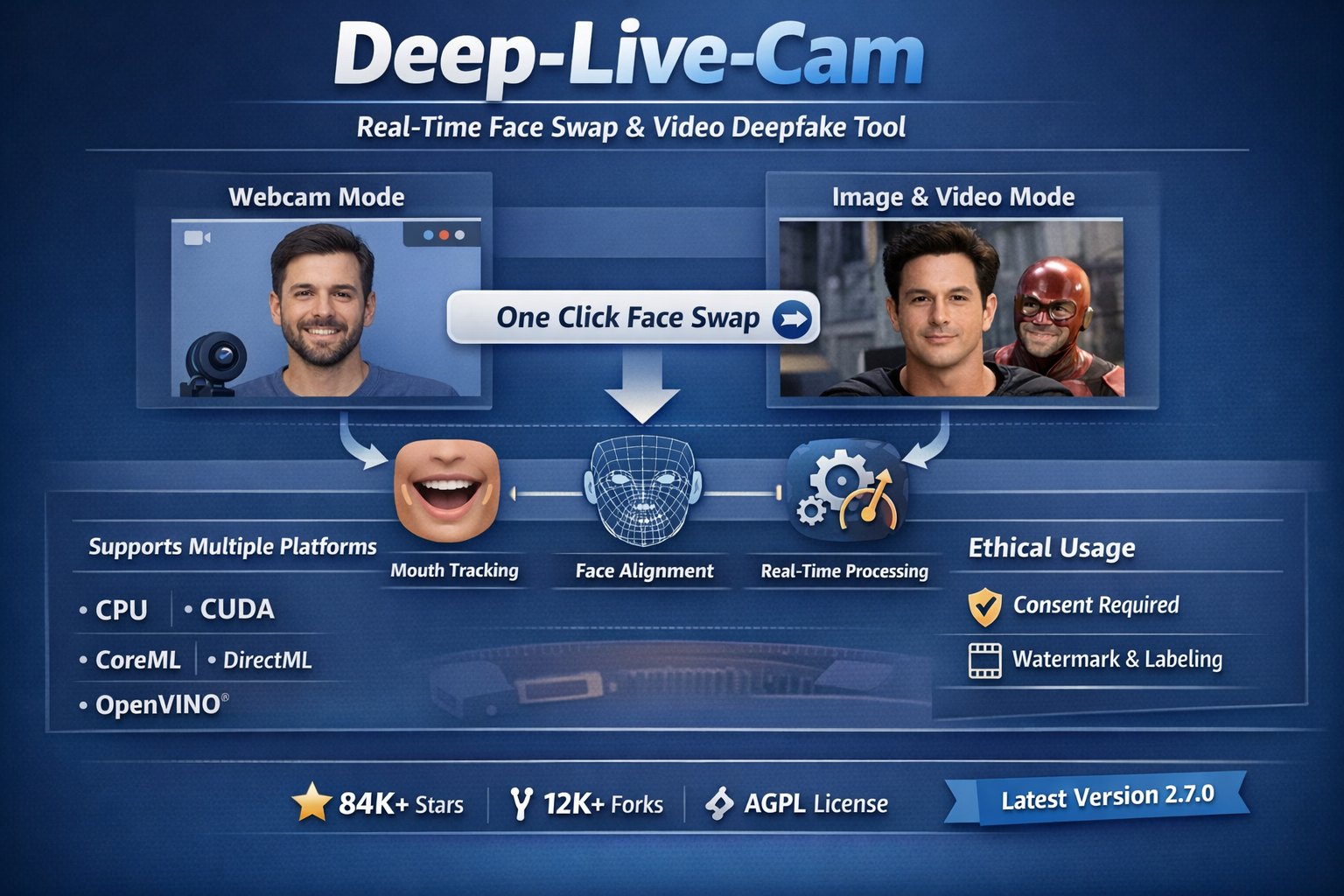
Deep-Live-Cam is an open-source project that enables real-time face swapping and video deepfakes with a single image, demonstrating the rapid progress in AI-generated media and raising ethical concerns.
Summary
Deep-Live-Cam is an open-source project focused on real-time face swapping and one-click video deepfake generation using only a single source image.
For people who are interested in IT, the project matters for two reasons at the same time:
- it shows how far real-time AI media generation has already progressed
- it shows why ethics, consent, and identity protection are becoming central topics in modern technology
In simple terms, Deep-Live-Cam is not just “another AI toy.” It is a strong example of how computer vision, generative media, and hardware acceleration are making live visual transformation much easier than many people expected.
What the Project Is
The GitHub repository describes Deep-Live-Cam as:
“Real-time face swap and video deepfake with a single click and only a single image.”
That is the project’s core promise. Instead of requiring a large custom dataset or a long training process, it aims to let users replace a face in:
- live webcam output
- recorded video
- image/video workflows
The repo also presents it as a tool for the AI-generated media industry, mentioning potential use cases such as:
- animating custom characters
- creating engaging content
- clothing/model visualization workflows
This makes Deep-Live-Cam relevant not just to technical hobbyists, but also to anyone tracking where AI media tools are heading.
Why This Project Matters
The biggest reason Deep-Live-Cam matters is that it compresses a once-complicated deepfake workflow into something much more accessible.
A few years ago, realistic face replacement often meant:
- complex research code
- large training datasets
- specialized technical skills
- slow offline rendering
Projects like Deep-Live-Cam show how quickly that has changed.
Today, the same basic idea can be packaged into a tool that supports:
- live webcam mode
- image/video mode
- multiple execution providers
- non-technical quick-start builds
- a much simpler user flow
That is why the project is important as a trend signal. It shows that synthetic media is moving from research into mainstream usability.
What It Does in Simple Terms
A beginner-friendly way to understand Deep-Live-Cam is this:
1. You provide a source face
The system uses one face image as the identity reference.
2. You choose a target
The target can be:
- a live webcam feed
- an image
- a video
3. The software swaps the face in real time or in rendered output
The result is a transformed stream or file where the target face is replaced or modified to resemble the source face.
That basic experience is why the project became widely discussed. The README presents the process for live mode in just a few clicks:
- select a face
- choose the camera
- press live
For a general IT audience, that simplicity is the story.
Key Features
1. Real-time webcam face swap
The project supports a live mode where a selected face can be applied to a camera feed.
Why it matters:
This is what makes the project feel surprising and immediate compared with offline-only deepfake tools.
2. Single-image source workflow
The repository emphasizes that the system works with only one source image.
Why it matters:
That greatly lowers the barrier to experimentation compared with older deepfake workflows.
3. Image and video processing
Beyond webcam use, the project also supports image/video mode and saving processed output.
Why it matters:
It gives the project broader use beyond live streaming.
4. Face mapping and many-faces support
The README shows features like face mapping and command-line options for --many-faces and --map-faces, allowing more advanced handling of multiple faces.
Why it matters:
This moves the project beyond the simplest “one face on one person” demo.
5. Mouth mask
The repo highlights a mouth mask feature designed to preserve the original mouth movement more accurately.
Why it matters:
This is one of the technical details that can make output look more convincing.
6. Multiple hardware backends
The README documents execution providers including:
- CPU
- CUDA for Nvidia
- CoreML for Apple
- DirectML for Windows
- OpenVINO for Intel
Why it matters:
This shows the project is not just a research prototype. It is trying to support real-world hardware diversity.
7. Quick-start builds for non-technical users
The README includes a quick-start path and explicitly says the manual installation requires technical skills and is not for beginners.
Why it matters:
It reflects a growing pattern in open-source AI: complex projects are increasingly packaged for wider audiences.
Why It Is Interesting for People in IT
Even if you never plan to use a face-swapping tool yourself, Deep-Live-Cam is still important because it reflects several major IT trends.
AI media is becoming real-time
The shift from slow rendering to live output is a major technical and product milestone.
Better hardware support is changing what feels possible
The project’s support for CUDA, CoreML, DirectML, OpenVINO, and CPU paths shows how much modern AI software depends on smart hardware abstraction.
Open-source projects are shaping public understanding of AI
Deep-Live-Cam is a strong reminder that breakthrough-feeling AI experiences are not only coming from large closed commercial platforms.
Identity is becoming a cybersecurity issue
As face-swapping quality improves, the question is no longer just “can this be done?”
It is also:
- how should it be labeled?
- how do people verify authenticity?
- how should platforms respond?
- what protections should exist for consent and impersonation?
That makes the project relevant to cybersecurity, digital trust, and media literacy, not only entertainment tech.
Ethical and Legal Reality
Any honest report on Deep-Live-Cam needs to address the ethical side directly.
The repository itself does this. The README says the project is intended as a productive tool for AI-generated media and includes built-in checks intended to block inappropriate material such as nudity, graphic content, and sensitive footage. It also says users should obtain consent when using a real person’s face and clearly label shared output as deepfake content.
That is important, because the same technology can be used for:
- creative character work
- parody and entertainment
- visual prototyping
but also for:
- impersonation
- deception
- harassment
- disinformation
So the real story is not simply that the project is technically impressive. It is that this kind of tool makes the ethics of synthetic media impossible to ignore.
Strengths
- Extremely clear value proposition
- Shows how mature real-time AI media tooling has become
- Supports live and offline workflows
- Works across several hardware backends
- Has very large open-source traction
- Makes a once-advanced workflow much more accessible
- Includes visible ethical disclaimers and content restrictions in the project README
Caveats
A balanced report should also mention the limits.
1. It is not a beginner manual-install project
The README explicitly says manual installation requires technical skills and is not for beginners.
2. Real-time quality depends on hardware
Although CPU mode exists, the repo notes it will be slower. The best experience depends heavily on the user’s hardware setup.
3. The technology is socially risky
Even when legally allowed, face-swap systems can easily cross ethical lines if used without consent or clear disclosure.
4. Public attention cuts both ways
The project has gained major visibility, but that visibility also means it is frequently discussed as a deception risk, not only as a technical achievement.
Current Momentum
Deep-Live-Cam has significant public momentum on GitHub. At the time of writing, the repository shows:
- about 84.3k stars
- about 12.3k forks
- 543 commits
- an AGPL-3.0 license
The repository also shows 11 releases, with 2.7 beta listed as the latest release on March 11, 2026.
That level of traction makes it more than a niche experiment. It is one of the more visible open-source synthetic-media projects on GitHub.
Why This Project Is Good News — and Also a Warning Sign
The “good news” angle is easy to see:
- the software is technically impressive
- it makes advanced AI media generation more accessible
- it demonstrates strong open-source innovation
- it shows how fast real-time computer vision is evolving
But there is also a warning inside the same story.
Deep-Live-Cam is a reminder that the most interesting AI projects are often also the most socially disruptive.
For people interested in IT, that makes the project especially worth watching. It is both:
- a sign of technical progress
- and a test of how society handles synthetic identity tools
Conclusion
Deep-Live-Cam is one of the clearest examples of how quickly AI-generated media is advancing.
In the simplest possible terms:
It turns real-time face swapping and video deepfakes into a much more accessible, open-source experience.
That makes it important not only for developers, but for anyone trying to understand the future of AI, media, identity, and trust online.
The project is impressive because of what it can do.
It is important because of what it means.
Sources
- GitHub repository: https://github.com/hacksider/Deep-Live-Cam