Public note
Claude-Mem Tries to Give Claude Code a Persistent Memory Layer
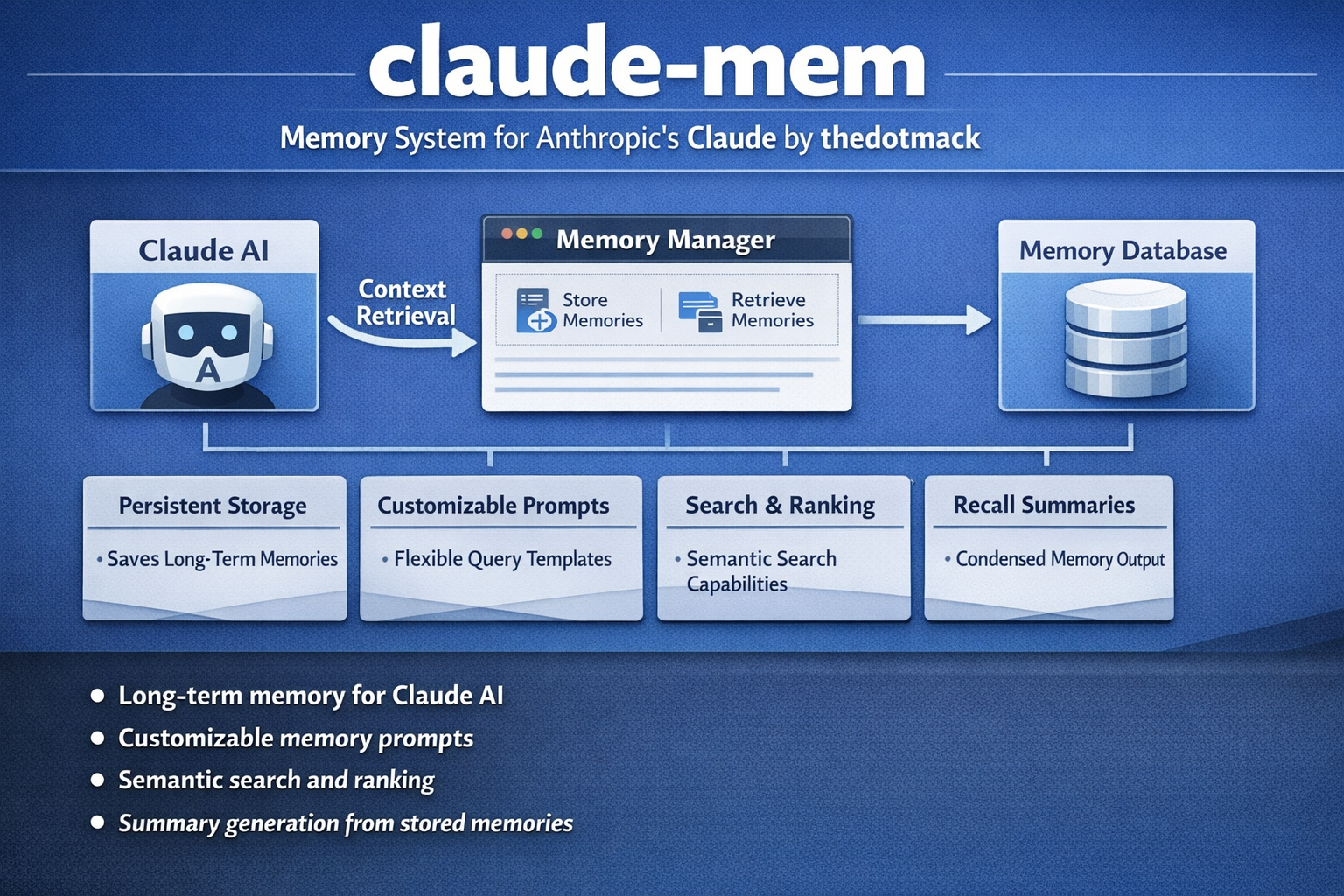
Claude-mem is an open-source plugin by thedotmack that captures, compresses, and retrieves context from coding sessions to enhance continuity for AI-assisted development environments like Claude Code.
Subheadline
Claude-mem is an open-source plugin by thedotmack that captures observations from coding sessions, compresses them into reusable memory, and injects relevant context back into future AI-assisted development workflows.
Lead
Most coding agents still begin each session with little or no memory of what happened before. That statelessness creates a familiar problem: developers and AI tools repeatedly rediscover project structure, revisit prior decisions, and lose continuity across long-running work. Claude-mem is designed as an answer to that problem.
The project, published by thedotmack, presents itself as a persistent memory compression system for Claude Code. In practice, it functions as a plugin and worker-based memory layer that captures what Claude does during coding sessions, summarizes those observations semantically, stores them, and makes relevant context available in later sessions. The goal is not to replace the coding assistant, but to reduce forgetting.
At a Glance
- Project: Claude-mem
- Owner: thedotmack
- What it is: An open-source persistent-memory plugin and worker service for Claude Code and related agent environments
- Primary purpose: Preserve useful coding-session context across sessions through observation capture, semantic summarization, storage, and retrieval
- Primary source type: GitHub repository and official documentation
- License: AGPL-3.0
- Install path:
npx claude-mem installor Claude Code plugin marketplace
What Happened
Claude-mem has grown from a Claude Code–specific memory plugin into a broader memory system that also documents integrations for tools such as Gemini CLI, OpenCode, Cursor, Windsurf, Claude Desktop, and OpenClaw. Its official docs describe a local worker service, search tools, context injection controls, and a real-time local web viewer, suggesting a project that is evolving from a simple plugin into a more general memory infrastructure for agentic development environments.
Recent release notes also indicate that the project remains under active iteration. For example, the GitHub releases page shows v11.0.1, published on April 15, 2026, with a configuration change that disables semantic inject by default, a sign that the maintainers are still tuning how much automatically recalled memory should enter future sessions.
Key Facts / Comparison
| Category | Source-grounded detail |
|---|---|
| Core identity | Claude-mem is described as a “persistent memory compression system” for Claude Code. |
| Main workflow | It automatically captures tool-usage observations, generates semantic summaries, and makes them available in later sessions. |
| Installation | Recommended installation is through npx claude-mem install or Claude Code plugin commands, not a plain global npm install. |
| Runtime model | Official docs describe a worker service running locally, with a default HTTP endpoint on localhost:37777. |
| Search model | Documentation describes an MCP-based search architecture with four tools and a token-efficient three-layer retrieval workflow. |
| Privacy controls | The README says users can exclude sensitive content from storage with <private> tags. |
| Visibility | The system includes a local web viewer for inspecting memory activity. |
| License | The repository is licensed under AGPL-3.0. |
Background and Context
Claude-mem is best understood as infrastructure for a recurring limitation in coding copilots: the lack of durable session memory. In ordinary use, a tool may understand the current prompt and the immediate project files, but forget prior reasoning, implementation detours, debugging history, or architecture decisions once a session ends.
Claude-mem’s design suggests that the project treats memory not as a flat log, but as a compressed knowledge pipeline. Instead of replaying entire transcripts, it captures observations from tool use, turns them into semantic summaries, and reintroduces only the context likely to matter later. That makes the project closer to a memory middleware layer than to a notes app or transcript archive.
Why This Matters
For teams and individual developers using AI heavily inside IDEs or coding CLIs, the biggest productivity cost is often not generation quality but continuity loss. If every session restarts from near-zero understanding, users pay the same context-loading cost repeatedly.
Claude-mem matters because it aims at that exact bottleneck. The project’s value proposition is not better code generation in isolation, but lower context re-explanation overhead over time. If it works as intended, the benefit is cumulative: an AI assistant becomes more useful across a project’s lifespan because it can recall prior observations, decisions, and patterns.
Insight and Industry Analysis
The interesting shift here is architectural. Many AI coding products talk about context windows, indexing, or repository retrieval. Claude-mem instead focuses on session-derived memory: what the agent observed, what tools it used, and what happened during real work.
That distinction matters. Code search tells an assistant what exists in a repository. Memory systems try to tell it what happened, why it mattered, and what should be carried forward. Claude-mem appears to sit in that second category.
There is also a broader platform signal in the documentation. By exposing a worker API, a search architecture, and multiple integration paths, the project is moving beyond a single-plugin identity. Conservatively interpreted, the official material suggests an attempt to become a reusable memory substrate for multiple AI-agent surfaces rather than just a Claude Code add-on.
Strengths, Limitations, and Open Questions
Strengths
- Clear problem focus: persistent project memory across sessions
- Automated workflow: capture, summarize, store, retrieve, and inject with minimal manual work
- Multiple integration paths: Claude Code, Gemini CLI, OpenCode, Cursor, OpenClaw, and related tooling appear in official docs
- Inspectable system: local web viewer and citation-style observation references make the memory layer more visible than a black box
- Cost-awareness: docs emphasize progressive disclosure and token-efficient retrieval patterns
Limitations
- Operational complexity: this is not just a lightweight package; official installation material references hooks, dependencies, and a worker service
- Configuration sensitivity: the recent release changing semantic injection defaults suggests retrieval behavior may need tuning
- Not a general knowledge graph: the sources support a memory compression and retrieval system, not a universal reasoning layer over all project artifacts
- Ecosystem dependence: the product’s usefulness depends on supported IDEs, CLI hooks, and surrounding AI-tool workflows
Open Questions
- How well does semantic compression preserve nuance from complex, long-lived engineering work?
- How stable is cross-tool behavior as upstream agent platforms change?
- What governance or retention controls will matter most for teams handling sensitive codebases?
- How much of the system’s benefit depends on careful configuration versus good defaults?
Technical Deep Dive
The official documentation describes Claude-mem as a system with several distinct pieces:
1. Observation capture
The plugin monitors session activity and records tool-usage observations during coding work.
2.Semantic summarization
Those observations are compressed into reusable memory rather than stored only as raw conversational history.
3.Worker service
Docs describe a local worker process and HTTP interface, with a default base URL on localhost:37777. This suggests the memory engine is separated from the IDE/plugin surface.
4.Search and retrieval
The search architecture page describes an MCP-based design with four tools and a three-layer workflow intended to keep retrieval token-efficient.
5.Context injection
Retrieved memory can be inserted into future sessions, though recent release notes show maintainers are actively refining how aggressive that injection should be.
6.Inspection and citations
The README documents a local web viewer and observation IDs, indicating that stored memories can be reviewed rather than remaining entirely hidden.
This architecture is notable because it separates storage and retrieval from the user-facing assistant. In other words, Claude-mem is not the assistant itself. It is a memory service sitting beside the assistant.
What to Watch Next
- Whether Claude-mem stabilizes its defaults for semantic injection and retrieval
- Whether the project’s multi-platform integrations mature into a consistent developer platform
- How teams respond to privacy and exclusion features such as
<private>tags - Whether the worker-and-search model becomes a standard pattern for AI coding memory systems
Conclusion
Claude-mem is a focused and increasingly ambitious project. At its core, it is a persistent memory system for AI coding sessions, built by thedotmack to help Claude Code and related tools stop forgetting what happened yesterday.
The sources do not support calling it a general autonomous agent framework, a generic note-taking tool, or a knowledge graph platform. What they do support is more specific and more useful: Claude-mem is infrastructure for compressing session history into reusable engineering memory. In a development ecosystem where continuity is often the missing layer, that makes it a technically meaningful project to watch.